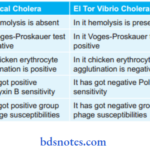
Vibrio Question 1. Write the difference between classical and El Tor vibrio cholera. Answer: Read And Learn More: Microbiology Question And Answers "Understanding Vibrio and Actinomyces through FAQs: Q&A explained" Actinomyces Question 2. Write a short note on lesions caused by actinomycosis and laboratory diagnostic features. Answer: Lesions … [Read more...] about Vibrio And Actinomyces Question And Answers
Microbiology
Enterobacteriaceae II Salmonella Question And Answers
Enterobacteriaceae II Salmonella Question 1. Describe laboratory diagnosis of typhoid fever. Or Write a note on laboratory diagnosis of enteric fever. Answer: Laboratory diagnosis of typhoid fever is done as: Identification of bacteria Demonstration of antibodies Demonstration of antigens "Steps to apply Salmonella knowledge in clinical practice: … [Read more...] about Enterobacteriaceae II Salmonella Question And Answers
Corynebacterium Question And Answers

Corynebacterium Question 1. Describe morphology, culture characteristics, and pathogenicity of Corynebacterium diphtheriae. Answer: It is gram-positive, non-acid-fast bacilli. Corynebacterium Diphtheriae Morphology It is a thin, slender gram-positive bacillus. It is 3 to 6 µ in length and 0.6 to 0.8 µ in width. It is non-capsulated, non-motile, … [Read more...] about Corynebacterium Question And Answers
Staphylococcus Question And Answers

Staphylococcus Question 1. Write a short note on staphylococcus. Or Write notes on staphylococci. Or Write briefly on laboratory identification of staphylococci. Answer: Staphylococcus are gram-positive cocci which occur in grapes-like cluster. Sir Alexander Ogston in 1880 discover Staphylococci. Morphology of Staphylococcus "Understanding Staphylococcus … [Read more...] about Staphylococcus Question And Answers
Non-Sporing Anaerobes Question And Answers
Non-Sporing Anaerobes Question 1. Write a short on gram-positive cocci. Answer: Following are the gram-positive cocci: Peptococcus Peptostreptococcus Peptoniphilus Parvimonas micro Anaerococcus Finegoldia Gallicola topobium Blantia Ruminococcus. "Understanding non-sporing anaerobes through FAQs: Q&A explained" Read And Learn More: … [Read more...] about Non-Sporing Anaerobes Question And Answers