• Skip to main content
  • Skip to secondary menu
  • Skip to primary sidebar
  • About Us
  • Terms of Use
  • Privacy Policy
  • Disclaimer
  • Contact Us
  • Sitemap

BDS Notes

BDS notes, Question and Answers

  • Public Health Dentistry
  • Periodontics
  • Pharmacology
  • Pathology
  • Orthodontics
    • Anchorage In Orthodontics
    • Mandibular Growth, Functional Matrix
    • Retention and Relapse
  • General Surgery
    • Cysts: Types, Causes, Symptoms
    • Maxillofacial Fractures, Disorders, and Treatments
    • Lymphatic Disorders
    • Neurological and Facial Disorders
  • Temporal And Infratemporal Regions
    • Spinal and Neuroanatomy
  • Dental Materials
    • Dental Amalgam
Home » Upper Pons Cross‑Section: Trigeminal Nuclei and Lemnisci Unpacked

Upper Pons Cross‑Section: Trigeminal Nuclei and Lemnisci Unpacked

November 16, 2025 by Joankessler parkland Leave a Comment

Upper Pons Cross‑Section: Trigeminal Nuclei and Lemnisci Unpacked

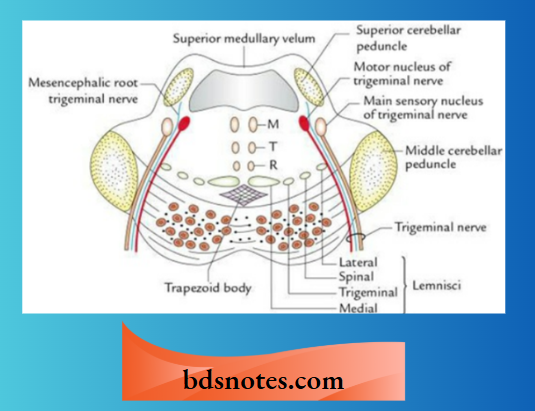
Question 1. Enumerate the main structures seen in the transverse section through the upper part of the pons.
Answer: The main structures seen in the transverse section through the upper part of the pons are as follows:

Pontocerebellar Angle Syndrome Explained: From CN VIII Schwannoma to Clinical Signs

  • The chief (main) sensory nucleus of the trigeminal nerve
  • Motor nucleus of the trigeminal nerve
  • The mesencephalic root of the trigeminal nerve
  • Trigeminal lemniscus
  • Lateral lemniscus

Brainstem And Cerebellar Peduncles

Question 2. Write a short note on the pontocerebellar angle syndrome.

Answer.  Causes Of Pontocerebellar Angle Syndrome

Involvement of the lateral region of the caudal part of the pons near the pontocerebellar angle by Schwannoma of CN 8.

cross section of pons anatomy

Clinical Features of Pontocerebellar Angle Syndrome

  • Ipsilateral deafness due to involvement of the cochlear nerve.
  • Ipsilateral imbalance and asynergia due to involvement of the vestibular nerve.
  • Ipsilateral lower motor neuron type of facial palsy due to involvement of the facial nerve.
  • Ipsilateral loss of pain and temperature on the face due to the involvement of the spinal nucleus and tract of CN 5.

Filed Under: Brain

Reader Interactions

Leave a Reply Cancel reply

Your email address will not be published. Required fields are marked *

Primary Sidebar

Recent Posts

  • Brainstem Anatomy Explained: Parts, Functions, and Clinical Significance
  • Medulla Oblongata Transverse Sections: Key Structures at Decussation Levels
  • Transverse Section of Medulla Oblongata: Upper Olive Level Structures Explained
  • Medial Medullary Syndrome and Pons Anatomy: Key Structures and Clinical Correlates
  • Upper Pons Cross‑Section: Trigeminal Nuclei and Lemnisci Unpacked
  • Midbrain Cross-Section at the Inferior Colliculus: Key Structures Explained
  • Medial Longitudinal Fasciculus (MLF): Anatomy, Pathways, and Functions
  • Cerebellum Simplified: Parts and Anatomical Lobes Explained
  • Cerebellar Nuclei Explained: Dentate, Interposed, and Fastigial Connections
  • Cerebellar Nuclei And Tracts – Structure, Connections And Functions
  • The Fourth Ventricle
  • Rhomboid Fossa
  • Central sulcus
  • Lobes Of The Brain
  • The Anatomy Of The Cerebral Cortex
  • Brodmann Area 4
  • Wernicke’s Area
  • Visual Cortex
  • Cerebral Dominance In Spatial Hearing
  • Paracentral Lobule

Copyright © 2025 · Magazine Pro on Genesis Framework · WordPress · Log in