Upper Limb Ischemia Important Question And Answers
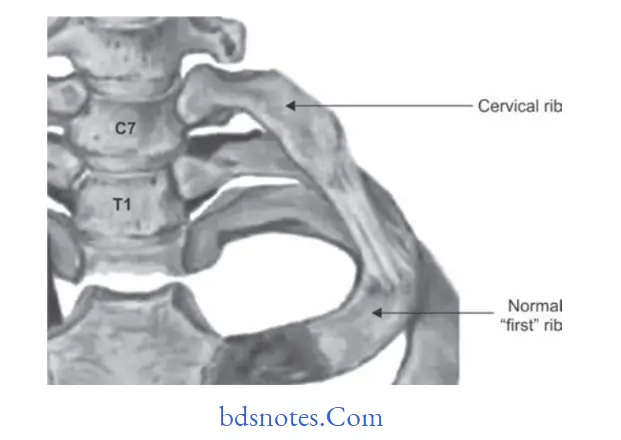
Question 1. Write a short note on the cervical rib.
Answer. This is an extra rib present in the neck in about l–2% of the population.
Commonly, it is unilateral, and in some cases, it is bilateral.
It is more frequently encountered on the right side. Ltt is the anterior tubercle of the transverse process of the 7th cervical vertebra, which attains excessive development and results ina cervical rib.
“Tips To Prevent Upper Limb Ischemia Naturally”
Read And Learn More: General Surgery Questions and Answers
Types Of Cervical Rib
- Type I: The free end of the cervical rib is expanded into a hard, bony mass that can be felt in the neck.
- Type II: Complete cervical rib extends from the C7 vertebra posteriorly to the manubrium anteriorly.
- Type III: Incomplete cervical rib, which is partly bony and partly fibrous.
- Type IV: A complete fibrous band that gives rise to symptoms but cannot be diagnosed by X-ray.
“Effective Ways To Manage Arm Ischemia Recovery“
Cervical Rib Clinical Features
- It is common in young females.
- Dull aching pain in the neck is caused by the y expanded bony end of the cervical rib.
- Upper limb ischemia is usually present.
- Ulnar nerve paralysis or weakness manifests as paralysis of interosseous muscles.
- A hard mass may be movable, visible, or palpable i he neck.
- On palpation, a thrill, nd on auscultation, a bruit can be heard in cases of post-statenotic dilatation.
“Step-By-Step Guide To Diagnosing Arm Ischemia”
“Best Practices For Managing Arm Artery Blockage”
Cervical Rib Differential Diagnosis
- Cervical spondylosis: This should be considered as a possibility in patients above the age of 40 years.
- Cervical disc protrusion and spinal cord tumors May mimic cervical rib with the predominant neurological feature.
- Carpal tunnel syndrome can occur due to various causes, such as myxoedema, rheumatoid arthritis, etc.
Predominant features of median nerve involvement, more so in menopausal women give a clue to the diagnosis. - Raynaud’s phenomenon.
“Comprehensive Overview Of Arm Ischemia Symptoms”
Cervical Rib Treatment
- Conservative: Patients with mild neurological symptoms are managed by shoulder girdle exercises or correction of faulty posture.
- Surgery:
- Excision of cervical rib including periosteum: This is called extraperiosteal excision of the cervical rib.
This is included with cervical sympathectomy if vascular symptoms are predominant. - If there is a thrombus in the subclavian artery, it is explore,d thed thrombus is removed, and the artery is repaired.
- At exploration, if a cervical rib is not found, divide the scalenus anterior muscle.
This is called sclerotome.y - If hyperabduction syndrome is diagnosed, pectoralis minor is divided from its insertion into the coracoid process.
- Excision of cervical rib including periosteum: This is called extraperiosteal excision of the cervical rib.
Leave a Reply