• Skip to main content
  • Skip to secondary menu
  • Skip to primary sidebar
  • About Us
  • Terms of Use
  • Privacy Policy
  • Disclaimer
  • Contact Us
  • Sitemap

BDS Notes

BDS notes, Question and Answers

  • Public Health Dentistry
  • Periodontics
  • Pharmacology
  • Pathology
  • Orthodontics
    • Anchorage In Orthodontics
    • Mandibular Growth, Functional Matrix
    • Retention and Relapse
  • General Surgery
    • Cysts: Types, Causes, Symptoms
    • Maxillofacial Fractures, Disorders, and Treatments
    • Lymphatic Disorders
    • Neurological and Facial Disorders
  • Temporal And Infratemporal Regions
    • Spinal and Neuroanatomy
  • Dental Materials
    • Dental Amalgam
Home » Shock: Types, Causes, Symptoms, Treatment

Shock: Types, Causes, Symptoms, Treatment

November 22, 2025 by Kristensmith Taylor Leave a Comment

Shock: Types, Causes, Symptoms, Treatment

Question 1. Discuss etiopathology and complications of shock.
Or
Write in brief on the etiopathogenesis of shock.
Answer:

Shock: It is defined as a clinical state of cardiovascular collapse characterized by an acute reduction of effective circulatory blood volume and inadequate perfusion of cells and tissues.

Shock Etiopathology
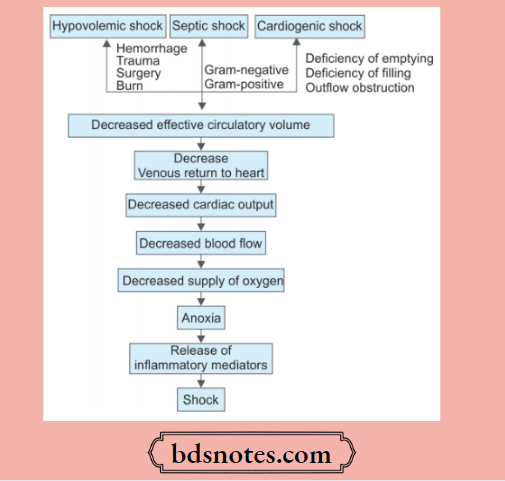
Hemodynamic Changes Etiopathology

Complications of Shock

Life-threatening complications in shock are due to hypoxic cell injury which results in immune- inflammatory responses and activation of various cascades. Various complications of shock are:

  • Acute respiratory distress syndrome
  • Disseminated intravascular coagulation
  • Acute renal failure
  • Multiple organ dysfunction syndrome

Types of shock in pathology

With the progression of the condition, the patient can develop a stupor, comma, and finally death.

Question 2. Write a short note on hypovolemic shock.
Answer:

Reduction in blood volume leads to hypovolemic shock.

Hypovolemic shock Pathogenesis
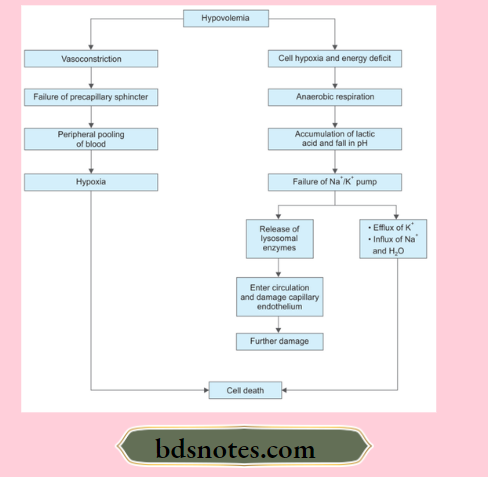
Hemodynamic Changes Pathogenesis

Hypovolemic shock Etiology

Hypovolemic shock treatment

  • Hemorrhage
    • External from wounds, open fractures
    • Internal from injury to the spleen, liver, mesentery or pelvis
  • Severe burns, which result in loss of plasma fluid
  • Vomiting and diarrhea of any cause lead to dehydration.
  • Excessive use of diuretics
  • Acute pancreatitis.

Filed Under: Pathology

Reader Interactions

Leave a Reply Cancel reply

Your email address will not be published. Required fields are marked *

Primary Sidebar

Recent Posts

  • Pulmonary Edema – Symptoms And Causes
  • Hemorrhage And Its Effect
  • Shock: Types, Causes, Symptoms, Treatment
  • The Etiopathogenesis Of Thrombosis
  • Deep Vein Thrombosis
  • Thrombosis
  • Difference Between Thrombosis And Coagulation
  • Pulmonary Embolism
  • Thrombus Formation
  • Shock: Signs, Causes, And Types
  • Embolism: Warning Signs And Symptoms
  • Edema
  • Types Of Embolism
  • Pulmonary Edema
  • Nutmeg Liver
  • Amyloidosis
  • HIV Transmission
  • Human Immunodeficiency Virus
  • Laboratory Diagnosis Of Amyloidosis
  • Autoimmune Disease

Copyright © 2025 · Magazine Pro on Genesis Framework · WordPress · Log in