• Skip to main content
  • Skip to secondary menu
  • Skip to primary sidebar
  • About Us
  • Terms of Use
  • Privacy Policy
  • Disclaimer
  • Contact Us
  • Sitemap

BDS Notes

BDS notes, Question and Answers

  • Public Health Dentistry
  • Periodontics
  • Pharmacology
  • Pathology
  • Orthodontics
    • Anchorage In Orthodontics
    • Mandibular Growth, Functional Matrix
    • Retention and Relapse
  • General Surgery
    • Cysts: Types, Causes, Symptoms
    • Maxillofacial Fractures, Disorders, and Treatments
    • Lymphatic Disorders
    • Neurological and Facial Disorders
  • Temporal And Infratemporal Regions
    • Spinal and Neuroanatomy
  • Dental Materials
    • Dental Amalgam
Home » Posterior Interosseous Nerve

Posterior Interosseous Nerve

October 30, 2025 by Joankessler parkland Leave a Comment

Posterior Interosseous Nerve

Question 1. Give the origin, insertion, nerve supply, and action of the supinator muscle.
Answer.

Supinator muscle Origin

Deep part:

From the supinator crest of the ulna and the triangular area in front of it (supinator fossa).

Deep Extensor Compartment Supinator

Superficial part:

From the lateral epicondyle of the humerus, the radial collateral ligament and annular ligament.

Supinator muscle Insertion

Upper one-third of the lateral surface of the radius between the anterior and posterior oblique lines.

Supinator muscle: Nerve supply

Posterior interosseous nerve (i.e., deep branch of the radial nerve [C6, C7]).

supinator muscle Action

Supination of the forearm.

Question 2. Describe the posterior interosseous nerve in brief.
Answer.

Posterior Interosseous Nerve is the deep terminal branch of the radial nerve.
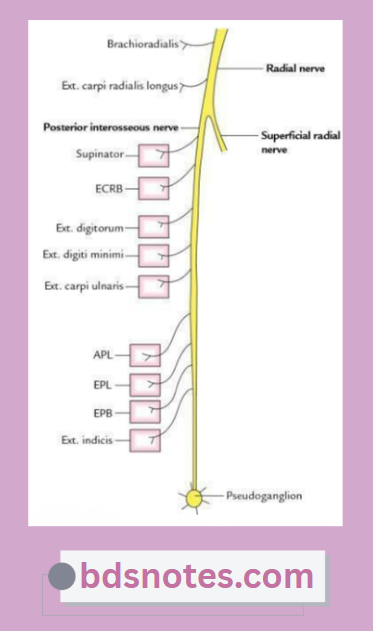
Radial Nerve To Pin Transition Diagram

Posterior Interosseous Nerve Origin

It arises from radial nerve just above cubital fossa in front of lateral epicondyle.

Posterior Interosseous Nerve Course

The nerve winds around the lateral side of radius and passes through the supinator muscle (between its superficial and deep laminae) to appear on the back of forearm.

Posterior Interosseous Nerve Termination

On the back of wrist where it ends by forming a pseudoganglion.

posterior interosseous nerve

Posterior Interosseous Nerve Branches

  • In the cubital fossa, it supplies:
    • Extensor carpi radialis brevis
    • Supinator (as it passes through the muscle)
  • In the back of forearm, it supplies:
    • Abductor pollicis longus
    • Extensor pollicis brevis
    • Extensor pollicis longus
    • Extensor digitorum
    • Extensor indicis
    • Extensor digiti minimi
    • Extensor carpi ulnaris

PIN nerve

Posterior Interosseous Nerve Applied anatomy

The lesion of posterior interosseous nerve produces wrist drop due to unopposed action of the flexor muscles.

Filed Under: Upper Limb

Reader Interactions

Leave a Reply Cancel reply

Your email address will not be published. Required fields are marked *

Primary Sidebar

Recent Posts

  • Triangular Space
  • Quadrangular Space
  • Auscultation
  • Latissimus Dorsi Muscle
  • Levator Scapulae
  • Scapular Region
  • Biceps
  • Arterial Anastomosis Of The Elbow
  • Posterior Compartment Of The Forearm
  • Coracobrachialis Muscle
  • Deep Brachial Artery
  • Brachial Artery Anatomy And Branches
  • Arm Muscles: Anatomy, Attachments, Innervation, Function
  • Muscles Of The Forearm
  • The Forearm Anatomy Of Muscle Compartments And Nerves
  • Posterior Interosseous Nerve
  • Muscles Of The Posterior Forearm
  • Anatomy, Shoulder and Upper Limb, Forearm Muscles
  • Back Of The Forearm
  • Muscles In The Anterior Compartment Of The Forearm

Copyright © 2025 · Magazine Pro on Genesis Framework · WordPress · Log in