Posterior Interosseous Nerve
Question 1. Give the origin, insertion, nerve supply, and action of the supinator muscle.
Answer.
Supinator muscle Origin
Deep part:
From the supinator crest of the ulna and the triangular area in front of it (supinator fossa).

Superficial part:
From the lateral epicondyle of the humerus, the radial collateral ligament and annular ligament.
Supinator muscle Insertion
Upper one-third of the lateral surface of the radius between the anterior and posterior oblique lines.
Supinator muscle: Nerve supply
Posterior interosseous nerve (i.e., deep branch of the radial nerve [C6, C7]).
supinator muscle Action
Supination of the forearm.
Question 2. Describe the posterior interosseous nerve in brief.
Answer.
Posterior Interosseous Nerve is the deep terminal branch of the radial nerve.
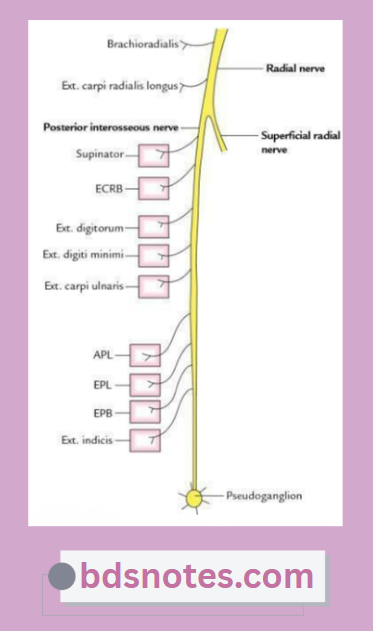
Posterior Interosseous Nerve Origin
It arises from radial nerve just above cubital fossa in front of lateral epicondyle.
Posterior Interosseous Nerve Course
The nerve winds around the lateral side of radius and passes through the supinator muscle (between its superficial and deep laminae) to appear on the back of forearm.
Posterior Interosseous Nerve Termination
On the back of wrist where it ends by forming a pseudoganglion.
posterior interosseous nerve
Posterior Interosseous Nerve Branches
- In the cubital fossa, it supplies:
- Extensor carpi radialis brevis
- Supinator (as it passes through the muscle)
- In the back of forearm, it supplies:
- Abductor pollicis longus
- Extensor pollicis brevis
- Extensor pollicis longus
- Extensor digitorum
- Extensor indicis
- Extensor digiti minimi
- Extensor carpi ulnaris
PIN nerve
Posterior Interosseous Nerve Applied anatomy
The lesion of posterior interosseous nerve produces wrist drop due to unopposed action of the flexor muscles.
Leave a Reply