• Skip to main content
  • Skip to secondary menu
  • Skip to primary sidebar
  • About Us
  • Terms of Use
  • Privacy Policy
  • Disclaimer
  • Contact Us
  • Sitemap

BDS Notes

BDS notes, Question and Answers

  • Public Health Dentistry
  • Periodontics
  • Pharmacology
  • Pathology
  • Orthodontics
    • Anchorage In Orthodontics
    • Mandibular Growth, Functional Matrix
    • Retention and Relapse
  • General Surgery
    • Cysts: Types, Causes, Symptoms
    • Maxillofacial Fractures, Disorders, and Treatments
    • Lymphatic Disorders
    • Neurological and Facial Disorders
  • Temporal And Infratemporal Regions
    • Spinal and Neuroanatomy
  • Dental Materials
    • Dental Amalgam
Home » Nifedipine

Nifedipine

October 14, 2025 by Kristensmith Taylor Leave a Comment

Nifedipine

Question 1. Write On Nifedipine As Antihypertensive.
Answer:

Nifedipine is a calcium channel blocker.

  • It comes under the subclass of calcium channel blockers, i.e. Dihydropyridines.
  • Nifedipine is a prototype drug.

Nifedipine: Mechanism of Action, Uses, and Side Effects

Nifedipine Mechanism of Action
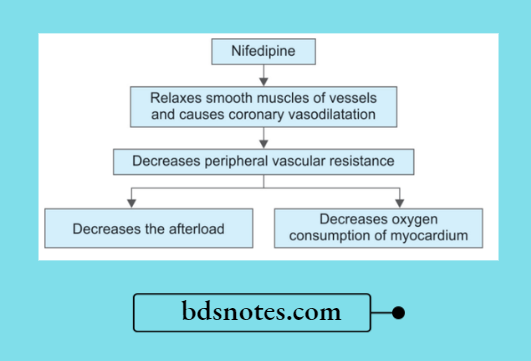
Antihypertensive Drugs Atenolol Mode Of Action

Nifedipine Adverse Effects

Palpitation, flushing, ankle edema, hypotension, headache, drowsiness, nausea, reflux tachycardia, fatigue, dizziness, and sedation.

Nifedipine Uses

  • Nifedipine is used in the treatment of Raynaud’s disease.
  • It is an alternate drug for premature labor.
  • It is used as a first-line drug for hypertension.
  • It is used as an antianginal drug.

Question 2. Discuss Basis Of Verapamil In Paroxysmal Supraventricular Tachycardia.
Answer:

Paroxysmal supraventricular tachycardia is a sudden atrial tachycardia.

  • It is a type of arrhythmia.
  • In paroxysmal supraventricular tachycardia, the atrial rate is 150–200 minutes.
  • Verapamil is a calcium channel blocker and lies in class IV of antiarrhythmic drugs.

Nifedipine for Hypertension and Angina: Dosage and Efficacy

Verapamil Mechanism of Action

Verapamil increases the repolarization of the AV node and decreases SA node discharge and suppresses ectopic foci due to this it undergoes antiarrhythmic action. So that’s why Verapamil is used in paroxysmal supraventricular tachycardia.

Filed Under: Pharmacology

Reader Interactions

Leave a Reply Cancel reply

Your email address will not be published. Required fields are marked *

Primary Sidebar

Recent Posts

  • Leukemoid Reaction
  • Oral Thrush
  • Epulis
  • Triangular Space
  • Quadrangular Space
  • Auscultation
  • Latissimus Dorsi Muscle
  • Levator Scapulae
  • Scapular Region
  • Biceps
  • Arterial Anastomosis Of The Elbow
  • Posterior Compartment Of The Forearm
  • Coracobrachialis Muscle
  • Deep Brachial Artery
  • Brachial Artery Anatomy And Branches
  • Arm Muscles: Anatomy, Attachments, Innervation, Function
  • Muscles Of The Forearm
  • The Forearm Anatomy Of Muscle Compartments And Nerves
  • Posterior Interosseous Nerve
  • Muscles Of The Posterior Forearm

Copyright © 2025 · Magazine Pro on Genesis Framework · WordPress · Log in