Messenger RNA Questions And Answers
Question 1.
- What are intervening sequences or introns?
- What is mRNA splicing?
Answer:
- Untranslated sequences that interrupt the coding sequence of a transcript and that are removed before translation begins.
- Removal of introns.
Question 2. Many eukaryotic genes contain noncoding introns that separate the coding sequences or exons of these genes. At what stage during the expression of these mosaic genes are the noncoding intron sequences removed?
Answer:
The entire nucleotide pair including the introns of the genes is transcribed by RNA polymerase to produce a primary transcript that still contains the intron sequences.
- The intron sequences are then “spliced kufi off the primary transcripts to produce the mature, functional RNA molecules.
- In the case of protein-encoding nuclear genes of higher eukaryotes, the introns are “spliced out “by complex ribosome-like macro-molecular structures called spliceosomes.
“Understanding mRNA through FAQs: Q&A explained”
Question 3. In what ways are ribosomes and spliceosomes similar? Different?
Answer:
- Ribosomes and spliceosomes both play essential roles in gene expression, and both are complex macromolecular structures composed of RNA and protein molecules.
- Ribosomes are located in the cytoplasm, and spliceosomes in the nucleus.
- Ribosomes are larger and more complex than spliceosomes.
Question 4. What would be the effect on the final protein product if an intervening sequence were removed with an extra base? One base? Too few?
Answer: Removing one base too many or too few would result in a shift in the reading frame during translation, thus radically altering the protein product.
Question 5. What product would DNA-RNA hybridization produce in a gene with five introns? No introns? Draw these hybrid molecules.
Answer: Five introns
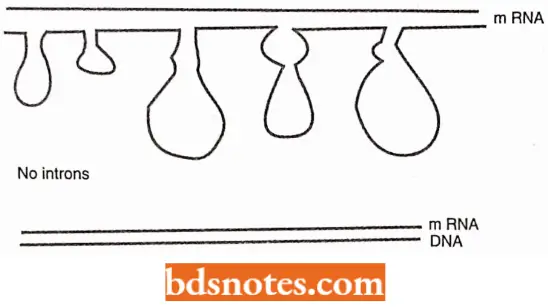
“Importance of studying mRNA for biology students: Questions explained”
Question 6. What are the differences between group I and group II introns?
Answer:
- Group 1 introns are self-splicing introns that require a guanine (G)-containing nucleotide for splicing.
- Group 2 introns are similar but do not require an external nucleotide for splicing. Group 1 and 2 introns are released as linear and lariat-shaped molecules respectively.
Question 7. Enhancers can often exert their effect from a distance; some enhancers are located thousands of bases upstream from the promoter. Propose an explanation to account for this.
Answer:
- Enhancers (E) bind activator proteins that also bind proteins of the polymerase at the promoter (P).
- In some eukaryotic genes, there are many enhancers, allowing numerous levels of control and forcing enhancers further and further upstream.
- For activators bound to enhancers to bind polymerase proteins, the DNA must lost around.

Question 8. For several decades, the dogma in biology has been that molecular reactions occurring in living cells are catalyzed by enzymes composed of polypeptides. We now know that the introns of some precursor RNA molecules such as the rRNA precursors in Tetrahymena are removed autocatalytically (“self-spliced”) with no involvement of any protein. What does the demonstration of autocatalytic splicing indicate about the dogma that biological reactions are always catalyzed by proteinaceous enzymes?
Answer:
“Self-splicing” of RNA precursors demonstrates that RNA molecules can also contain catalytic sites; this property is not restricted to proteins.
“Common challenges in understanding mRNA effectively: FAQs provided”
Question 9. What components of the introns of nuclear genes that encode proteins in higher eukaryotes are conserved and required for the correct excision of intron sequences from primary transcripts by spliceosomes?
Answer:
- The introns of protein-encoding nuclear genes of higher eukaryotes almost without exception begin (5′) with GT and end (3′) with AG.
- In addition, the 3′ subterminal A in the “TACTAAC box” is completely conserved; this A is involved in bond formation during intron excision.
Question 10.
1. Which of the following nuclear pre-mRNA nucleotide sequences potentially contains an intron?
- 5′-CCAUGGCGCUAACACUGCCAAUUGGCCAAUACUGACCUGAAGCAUCAGCCAA-3′
- S’AGUCUCAUCUGUCCAUUGACUUCGAAACUGAAUCGUAACUCCUACGUCUAUGGA-3′
- 5-GCUGUUUGUCAUGACUGACUGGUCACUAUCGUACUAACCUGUCAUGCAAUGUC-3′
- 5′-AGCAGUUCUGUCGCCUCGUGGUGCUGGCUGGCCCUUCGUCGCUCGGGCUUAGCUA-3′
- 5′-UUCGCAUGACGUACUUCUGAGACUACUACUACUAACGCAUCGAGUCUCAA-3′
2. One of the five pre-mRNAs shown above is a likely candidate for splicing out an intron sequence. What mRNA nucleotide sequence would one expect to result from this splicing event?
Answer:
- Sequence 5. It contains the conserved intron sequences: a 5′ GU, a 3′ AG, and a UACUAAC internal sequence providing a potential bonding site for intron excision. Sequence 4 has a 5’GU and 3′ AG, but contains no internal A for the bonding site during intron excision.
- 5′- UAGUCUCAA-3′; the putative intron from the 5′ GU through the 3’AG has been removed.
“Steps to explain the structure of mRNA: Codons vs exons: Q&A guide”
Messenger RNA Multiple Choice Questions And Answers
Question 1. Nuclear DNA sends information for protein synthesis through
- TRNA
- MRNA
- RRNA
- All the above
Answer: 2. MRNA
Question 2. The RNA carries the genetic message from the nucleus to the ribosome
- HnmRNA
- MRNA
- TRNA
- RRNA
Answer: 2. MRNA
Question 3. The type of RNA specifically responsible for directing the proper sequence of amino acids in protein synthesis is
- Chromosomal RNA
- RRNA
- TRNA
- MRNA
Answer: 4. MRNA
Question 4. Maximum formation of mRNA occurs in
- Cytoplasm
- Nucleolus
- Ribosome
- Nucleoplasm
Answer: 4. Nucleoplasm
Question 5. The ribozyme is an RNA
- Without sugar
- With extra phosphate
- With enzymatic property
- Without phosphate
Answer: 3. With enzymatic property
“Role of mRNA in transcription and translation: Questions answered”
Question 6. MRNA is a complimentary copy of
- TRNA
- RRNA
- Ribosomal DNA
- A single strand of DNA
Answer: 4. A single strand of DNA
Question 7. The cap structure of mRNA is of methyl GTP and the tail of
- Methionine
- Formylmethionine
- Poly A
- UAG codon
Answer: 3. Poly A
Question 8. Synthesis of mRNA molecule is terminated by__factor
- Alpha
- Beta
- Sigma
- Rho
Answer: 4. Rho
“Early warning signs of gaps in understanding mRNA basics: Common questions”
Question 9. Which RNA has having least age?
- MRNA
- TRNA
- RRNA
- None of these
Answer: 1. MRNA
Leave a Reply