• Skip to main content
  • Skip to secondary menu
  • Skip to primary sidebar
  • About Us
  • Terms of Use
  • Privacy Policy
  • Disclaimer
  • Contact Us
  • Sitemap

BDS Notes

BDS notes, Question and Answers

  • Public Health Dentistry
  • Periodontics
  • Pharmacology
  • Pathology
  • Orthodontics
    • Anchorage In Orthodontics
    • Mandibular Growth, Functional Matrix
    • Retention and Relapse
  • General Surgery
    • Cysts: Types, Causes, Symptoms
    • Maxillofacial Fractures, Disorders, and Treatments
    • Lymphatic Disorders
    • Neurological and Facial Disorders
  • Temporal And Infratemporal Regions
    • Spinal and Neuroanatomy
  • Dental Materials
    • Dental Amalgam
Home » Management Of Hypertension

Management Of Hypertension

October 13, 2025 by Kristensmith Taylor Leave a Comment

Management Of Hypertension

Discuss The Management Of Hypertension.
Answer:

  • Nonpharmacological methods which control hypertension are weight reduction, a decrease in sodium intake, restriction of alcohol, and physical
    exercise, mental relaxation, smoking cessation, and taking a potassium-rich diet.
  • In pharmacological treatment, various factors, i.e., age, sex, cost of the drug, complications, etc., are helpful in the selection of an appropriate antihypertensive drug.
  • Drugs used in the treatment of initial hypertension are ACE inhibitors, angiotensin receptor blockers, calcium channel blockers, and thiazides.
  • Treatment should be started with a single agent. Combination therapy should be applied to patients who do not respond to single-drug therapy.
  • Below is the regimen for the treatment of hypertension.

It is administered to two types of people, i.e.
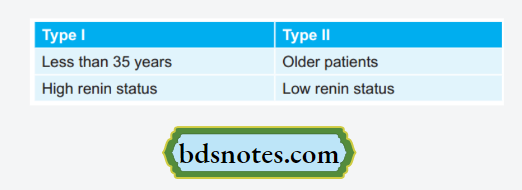
Age Dependent Hypertension Classification

A (ACE inhibitor)        C (Calcium channel Blocker)
Or                               Or
B (β blocker)               D (Diuretics)

  • If BP is not controlled, then use a single drug from another group, i.e., A is replaced by C or B is replaced by D, or vice versa.
  • If BP is still not controlled, then a drug regimen is started, i.e., one drug from the first group and another drug from the second group, i.e., A + C or A + D
    • Finally, A + B or C + D can be tried, but it has less additive effect on BP.
    • B + C is contraindicated: Produces cardiac depressant action.
  • If BP is still not controlled, then use a triple-drug regimen.
    • A + C + D is an ideal regimen.

Management of Hypertension: Treatment Guidelines and Strategies

Various Dosages Along With The Indications Of Antihypertensive Drugs
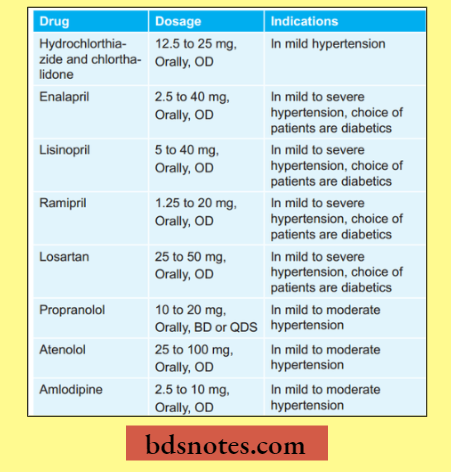
First Line Antihypertensive Drugs Table

Filed Under: Pharmacology

Reader Interactions

Leave a Reply Cancel reply

Your email address will not be published. Required fields are marked *

Primary Sidebar

Recent Posts

  • Leukemoid Reaction
  • Oral Thrush
  • Epulis
  • Triangular Space
  • Quadrangular Space
  • Auscultation
  • Latissimus Dorsi Muscle
  • Levator Scapulae
  • Scapular Region
  • Biceps
  • Arterial Anastomosis Of The Elbow
  • Posterior Compartment Of The Forearm
  • Coracobrachialis Muscle
  • Deep Brachial Artery
  • Brachial Artery Anatomy And Branches
  • Arm Muscles: Anatomy, Attachments, Innervation, Function
  • Muscles Of The Forearm
  • The Forearm Anatomy Of Muscle Compartments And Nerves
  • Posterior Interosseous Nerve
  • Muscles Of The Posterior Forearm

Copyright © 2025 · Magazine Pro on Genesis Framework · WordPress · Log in