• Skip to main content
  • Skip to secondary menu
  • Skip to primary sidebar
  • About Us
  • Terms of Use
  • Privacy Policy
  • Disclaimer
  • Contact Us
  • Sitemap

BDS Notes

BDS notes, Question and Answers

  • Public Health Dentistry
  • Periodontics
  • Pharmacology
  • Pathology
  • Orthodontics
    • Anchorage In Orthodontics
    • Mandibular Growth, Functional Matrix
    • Retention and Relapse
  • General Surgery
    • Cysts: Types, Causes, Symptoms
    • Maxillofacial Fractures, Disorders, and Treatments
    • Lymphatic Disorders
    • Neurological and Facial Disorders
  • Temporal And Infratemporal Regions
    • Spinal and Neuroanatomy
  • Dental Materials
    • Dental Amalgam
Home » Blood Vasodilator Drugs

Blood Vasodilator Drugs

October 13, 2025 by Kristensmith Taylor Leave a Comment

Blood Vasodilator Drugs

Question 1. Discuss Blood Vasodilator Drugs.
Answer:

Blood vasodilator drugs are of two types:

  • Arteriolar: Hydralazine, Minoxidil, and Diazoxide
  • Arteriolar + Venous: Sodium nitroprusside.

Blood Vasodilator Drugs: Mechanism of Action and Uses

Mechanism Of Action Of Arteriolar Vasodilator
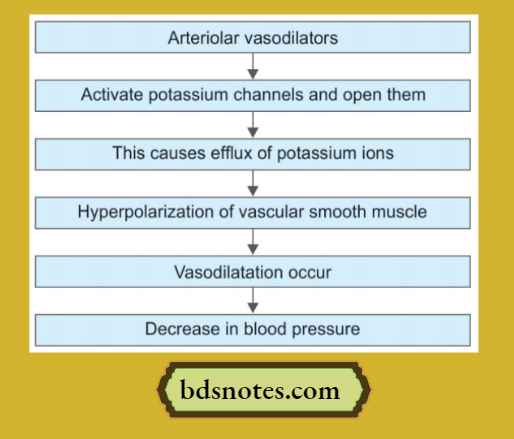
Hyperpolarization Induced Vasodilation

Mechanism Of Action Of Arteriolar + Venous Vasodilators

Balanced Venous Arteriolar Dilation_Nitroprusside

Blood Vasodilator Drugs Uses

  • Vasodilator drugs are preferred antihypertensive drugs during pregnancy.
  • They are used in moderate to severe hypertension when not controlled by first-line drugs.
  • They are used in hypertensive emergencies.

Question 2. Discuss Diuretics In Hypertension.
Answer:

Diuretics as antihypertensive drugs are classified as:

  • Thiazides: Hydrochlorthiazide
  • High ceiling: Furosemide
  • K+ sparing: Spironolactone.

Diuretics Mechanism of Action

  • Diuretics are weak antihypertensives
  • Diuretics cause loss of sodium and water in urine, due to which there is a decrease in cardiac output and hence a fall in BP.
  • Due to direct loss of sodium, arterioles respond less to noradrenaline and hence less vasoconstriction and a fall in BP.

Vasodilators: Types, Indications, and Clinical Applications

Drawbacks Of Diuretics As Antihypertensives

  • Hypokalemia: Muscle pain, impotence, and fatigue
  • Proinsulin in the presence of potassium ions is converted to insulin, so due to hypokalemia, it precipitates diabetes.
  • It increases cholesterol and triglycerides.
  • It increases the chances of sudden cardiac death.

Diuretics Uses

  • They are used for hypertension
  • They are used in hypertensive emergencies.

Filed Under: Pharmacology

Reader Interactions

Leave a Reply Cancel reply

Your email address will not be published. Required fields are marked *

Primary Sidebar

Recent Posts

  • Leukemoid Reaction
  • Oral Thrush
  • Epulis
  • Triangular Space
  • Quadrangular Space
  • Auscultation
  • Latissimus Dorsi Muscle
  • Levator Scapulae
  • Scapular Region
  • Biceps
  • Arterial Anastomosis Of The Elbow
  • Posterior Compartment Of The Forearm
  • Coracobrachialis Muscle
  • Deep Brachial Artery
  • Brachial Artery Anatomy And Branches
  • Arm Muscles: Anatomy, Attachments, Innervation, Function
  • Muscles Of The Forearm
  • The Forearm Anatomy Of Muscle Compartments And Nerves
  • Posterior Interosseous Nerve
  • Muscles Of The Posterior Forearm

Copyright © 2025 · Magazine Pro on Genesis Framework · WordPress · Log in