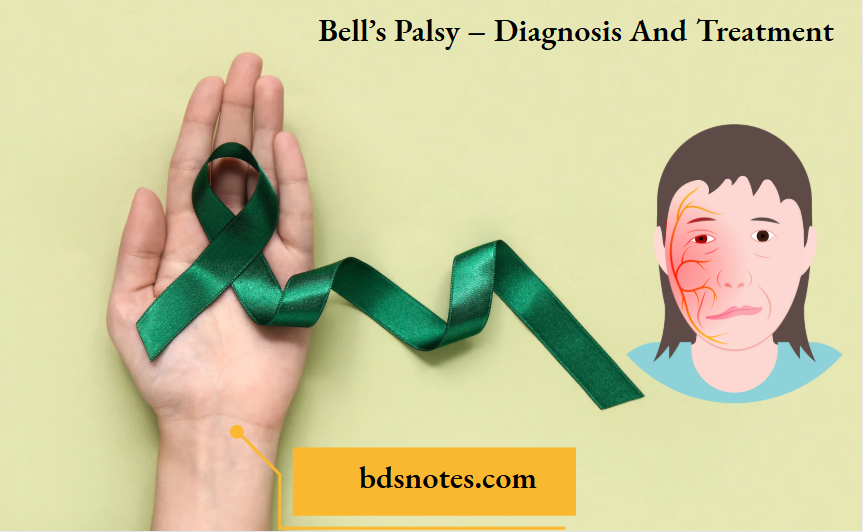
Bell’s Palsy – Diagnosis And Treatment
Facial palsy refers to the paralysis of facial muscles.
“Difference Between Bell’S Palsy And Stroke”
Facial palsy is of two types
- Upper motor neuron palsy
- Lower motor neuron palsy or Bell’s palsy
Bell’S Palsy
Upper Motor neuron Palsy
- It affcets mainly muscles of lower part of face and is never complete.
- It is seldom isolated palsy.
- The emotional movements are preserved.
- There is no muscle contracture.
- There is no reaction of degeneration.
- Electromyography and nerve conduction is normal.

Read And Learn More: Neurological and Facial Disorders: Causes, Diagnosis, and Treatment Strategies
lower Motor neuron Palsy or Bell’s Palsy
It is also called as 7th nerve paraplegia or facial palsy.
Bell’S Palsy Diagnosis
Bell’s Palsy Etiology
- Cold: It occurs after exposure to cold.
- Trauma: Extraction of teeth or injection of local anesthetic may damage the nerve and causes subsequent paralysis.
- Surgical procedure: Such as removal of parotid gland tumor in which the facial nerve is sectioned can also cause facial paralysis.
- Tumors: Tumors of the cranial base, Parapharyngeal space and infratemporal fossa cause facial nerve palsy.
- Familial: Familial and hereditary occurrence is also reported in case of Bell’s palsy.
Facial canal and middle ear neoplasms may lead to Bell’s palsy.
“Facial Droop And Bell’S Palsy Connection“
Bell’S Palsy Treatment
“Role Of Viral Infections In Bell’S Palsy”
Bell’s Palsy Clinical Features
- Bell’s Palsy is in older age group.
- Female predilection is most common.
- There is presence of paralysis over one side of the face.
- Drooping of angle of mouth is present over the affcted side and saliva is drooling from the affcted side.
- Patient is unable to raise the eyebrow of the affcted side.
- Patient is unable to close the eye over affcted side and tears continuously roll down.
- Eyeball rolls upward when attmpted to close the eye, this is known as Bell’s phenomenon.
- Over the affcted side, patient has lost the taste sensation.
Facial Nerve Paralysis – Bell’S Palsy
“Red Flags Of Bell’S Palsy”
- Patient complaints of pain in or behind the ear.
- Presence of numbness over the affcted side of face.
- Patient has mask-like appearance when he/she tries to smile.
- There is diffilty in blowing or clenching
- Obliteration of nasolabial fold
- Presence of wide palpebral fisure
- Presence of Epiphora.
“Can Stress Trigger Bell’S Palsy?”
Bell’s Palsy Treatment
Medicinal Treatment
- Patients with Bell’s palsy have excellent prognosis.
Treatment of Bell’s palsy is controversial as spontaneous recovery is present. - Treatment is given to the patients who have onset of paralysis under 1 to 4 days of an initial visit.
- Corticosteroids, i.e. prednisolone 1 mg/kg or 60 mg per day for 6 days followed by the taper of 10 days.
- Antiviral drugs can be given in the patients in which bell’s palsy is associated with herpes infection.
- In Bell’s palsy eye of the patient is at risk for drying which cause corneal abrasion and corneal ulcer.
Eye care consists of inducing the artificial tears in day-time along with eyeglasses. At night, eye lubricant can be used.
“Risk Factors For Developing Bell’S Palsy”
Acute Facial Nerve Palsy (Bell’S Palsy)
Bell’s Palsy Surgical Treatment
- Surgical treatment for Bell’s palsy is surgical decompression and anastomosis of the nerve.
In this facial and hypoglossal nerve get anastomosed which helps in restoring the partial function. - Nerve grafting using greater auricular nerve, sural nerve,lateral cutaneous nerve of thigh or hypoglossal nerve.
- Suspension of angle of mouth to zygomatic bone using temporal fascia sling.
- Lateral tarsorrhaphy: This prevents corneal ulceration
- Medial canthus reconstruction: To decrease epiphora
- Cross facial nerve transplantation from opposite side using its insignifiant branches
- Dynamic neurovascular muscle graft
- Upper lid gold weights to protect cornea
Leave a Reply