Dental Casting Investment Material An investment can be described as a ceramic material, which is suitable for forming a mold into which molten metal or alloy is cast. The procedure for forming the mold is described as “investing”. Materials such as gypsum, phosphate, and silicate are used for investment as they can withstand higher temperatures of burnout and casting … [Read more...] about Dental Casting Investment Materials: Types, Composition, and Applications
Flux and Anti-Flux in Soldering: Types, Functions, and Applications in Dentistry
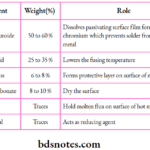
Soldering Fluxes Flux in Dentistry Flux is the compound that is applied to the metal surfaces which is to be joined to prevent the formation of oxides which reduce the strength of soldered area. "Importance Of Flux In Preventing Oxidation During Soldering" The function of Flux in Dentistry: Flux plays three roles, i.e. Flux removes impurities, i.e. dirt, oil, … [Read more...] about Flux and Anti-Flux in Soldering: Types, Functions, and Applications in Dentistry
Dental Solders: Types, Properties, and Applications in Dentistry
Soldering Welding in Dentistry The word soldering is used if two pieces of metal are joined by means of a third (filer) metal. Ideal Requirements of Dental Solder: It should melt at a low temperature. When melted, it should be wet and flow freely over the parent metal. Its color should match that of the metal being joined. It should be resistant to tarnish and … [Read more...] about Dental Solders: Types, Properties, and Applications in Dentistry
Welding Techniques in Dentistry: Types, Applications, and Common Failures
Welding Techniques In Dentistry Welding in Dentistry Welding is the process by which two pieces of similar metals are joined together without addition of another metal. Types of Welding: Cold welding: In this type of welding, there is no use of heat. This is carried out by hammering or pressure, for example, Gold foil filing Hot welding: In this type of welding, … [Read more...] about Welding Techniques in Dentistry: Types, Applications, and Common Failures
Soldering vs. Welding in Dentistry
Soldering And Welding Soldering: Soldering is a process in which two or more metals are joined together by melting and flowing a filler metal (solder) into the joint. Welding: Welding is the process by which two pieces of similar metals are joined together without the addition of another metal. Laser welding Laser welding is a recent advancement in the … [Read more...] about Soldering vs. Welding in Dentistry