• Skip to main content
  • Skip to secondary menu
  • Skip to primary sidebar
  • About Us
  • Terms of Use
  • Privacy Policy
  • Disclaimer
  • Contact Us
  • Sitemap

BDS Notes

BDS notes, Question and Answers

  • Public Health Dentistry
  • Periodontics
  • Pharmacology
  • Pathology
  • Orthodontics
    • Anchorage In Orthodontics
    • Mandibular Growth, Functional Matrix
    • Retention and Relapse
  • General Surgery
    • Cysts: Types, Causes, Symptoms
    • Maxillofacial Fractures, Disorders, and Treatments
    • Lymphatic Disorders
    • Neurological and Facial Disorders
  • Temporal And Infratemporal Regions
    • Spinal and Neuroanatomy
  • Dental Materials
    • Dental Amalgam
Home » Amyloidosis

Amyloidosis

November 20, 2025 by Kristensmith Taylor Leave a Comment

Amyloidosis

Write a short note on Amyloidosis.
Or
Write a short answer on amyloidosis.
Answer:

Amyloidosis is the term used for a group of diseases characterized by the extracellular deposition of a fibrillar proteinaceous substance called amyloid.

Classification of Amyloidosis
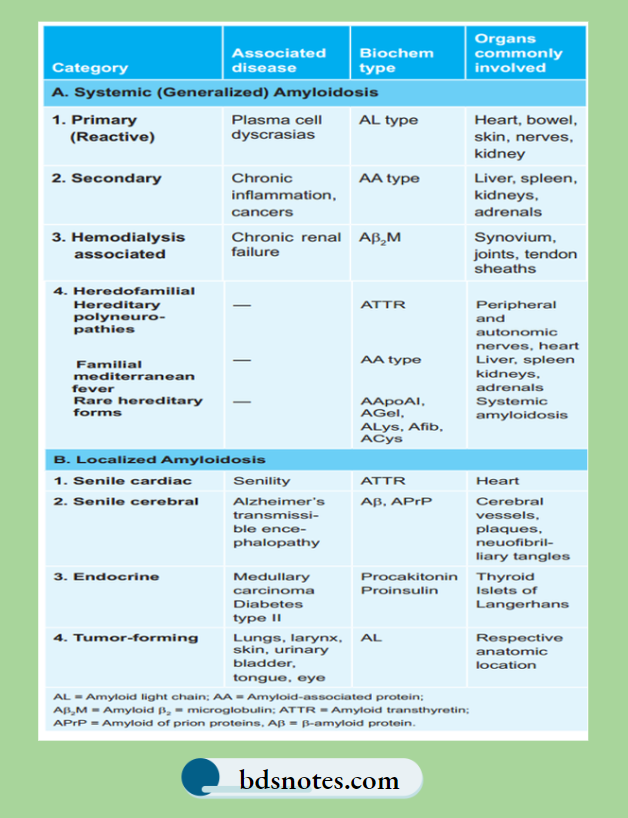
Including Amyloidosis-Classification-Of-Amyloidosis

Primary Amyloidosis

  • Biochemical Composition: AL protein
  • Associated Organ: Kidney, heart, bowel, nerve, and skin
  • Associated disease: Plasma cell dyscrasias, multiple myeloma, B-cell lymphoma.

Amyloidosis Pathogenesis

Morphology of Amyloidosis

  • Primary amyloidosis: This affects the kidney, liver, spleen, lymph node, adrenal gland, and thyroid gland
  • Secondary amyloidosis: This affects the heart, kidney, GIT, peripheral nerves, skin, and tongue.

Amyloidosis Gross Features

  • Affected organs are fim, enlarged, and waxy.
  • Painting the cut surface with iodine imparts yellow color which changes to bluish violet after the application of sulphuric acid.

Amyloidosis pathology

Pathologic Changes in Amyloidosis of Organ

  • The affected organ is usually enlarged, pale, and rubbery cut surface shows fim, waxy and translucent parenchyma.
  • The deposits of amyloid are found in extracellular locations, initially in the walls of small blood vessels producing microscopic changes and effects.

Filed Under: Pathology

Reader Interactions

Leave a Reply Cancel reply

Your email address will not be published. Required fields are marked *

Primary Sidebar

Recent Posts

  • Edema
  • Types Of Embolism
  • Pulmonary Edema
  • Nutmeg Liver
  • Amyloidosis
  • HIV Transmission
  • Human Immunodeficiency Virus
  • Laboratory Diagnosis Of Amyloidosis
  • Autoimmune Disease
  • Etiopathogenesis Of Amyloidosis
  • Type IV Hypersensitivity
  • Lardaceous Spleen
  • The Changing Concepts Of Amyloid
  • Leukocyte Extravasation
  • Chemical Mediators Of Inflammation
  • Periodontal Disease
  • Primary Pulmonary Tuberculosis
  • Primary Complex
  • Syphilis – Symptoms And Causes
  • Congenital Syphilis

Copyright © 2025 · Magazine Pro on Genesis Framework · WordPress · Log in