The Lymphoid System Question And Answers
Question 1. Write short notes on the types and staging of Hodgkin’s disease.
Answer:
Types of Hodgkin’s Disease.
“Understanding the role of the lymphoid system in immunity”
- Classic Hodgkin’s Disease:
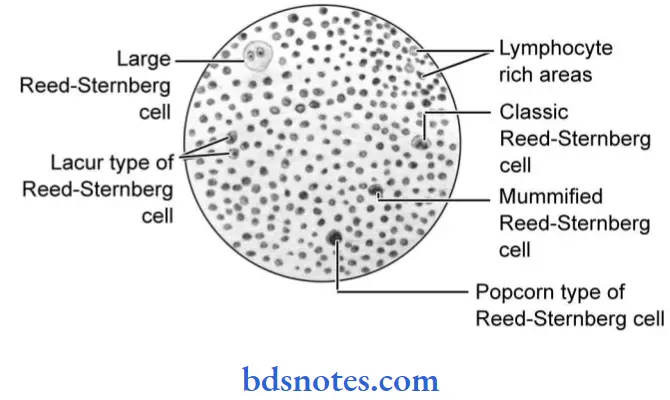
- Nodular Sclerosis Hodgkin’s Disease: Morphology shows a nodular pattern. The broadband of fibrosis divides the node into nodules. The capsule is thick. Lacunar type Reed-Sternbergcell which has a monolobated or multilobated nucleus and a small nucleolus with abundant and pale cytoplasm.
- Mixed Cellularity Hodgkin’s Disease: Infiltrate is diffuse. Reed Sternberg Cells are of classic type. It affects abdominal lymph nodes and the spleen.
- Lymphocyte-Depleted Hodgkin’s Disease: The infiltrate is diffuse and often appears hypocellular. A large number of Red-Sternberg cells and bizarre sarcomatous variants are present.
- Lymphocyte-Rich Classic Hodgkin’s Disease: In this Reed-Sternberg cells of classic and lacunar variety are observed with background infiltrate of lymphocytes.
- Nodular lymphocyte predominant Hodgkin’s Disease: In this variant of Reed-Sternberg cells the lymphocytic and histiocytic cells or popcorn cells are seen within a background of inflammatory cells, predominantly benign lymphocytes.
“Importance of studying the lymphoid system for better healthcare outcomes”
Read And Learn More: Pathology Questions and Answers
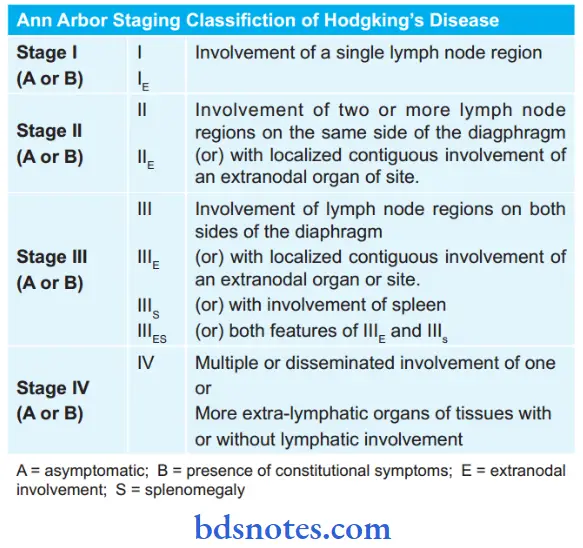
Staging of Hodgkin’s Disease
“Common challenges in diagnosing and managing lymphoid system disorders”
Question 2. Write a short note on Hodgkin’s Disease.
Answer:
Thomas Hodgkin first described Hodgkin’s disease in 1832. It is a malignant lymphoma.
Hodgkin’s Disease Predisposing Factors
- Epstein Barr virus is involved in causing the disease.
- Patients with HIV infection have a higher incidence.
- Genetic predisposition can be present.
“Steps to explain the anatomy of the lymphoid system”
Hodgkin’s Disease Clinical Features
- It occurs in young adults and males are more commonly affected.
- There is a painless enlargement of one or more cervical lymph nodes
- Lymph node enlargement occurs in the cervical area, axilla, inguinal area, and Waldeyer’s ring.
- Nodes are firm and rubbery in consistency
“Role of lymph nodes in filtering harmful substances”

“How does the spleen contribute to immune function?”
Hodgkin’s Disease Histology
- Nodular Sclerosis Hodgkin’s Disease
- Morphology shows a nodular pattern.
- Broadbands of fiers divide nodes into nodules
- The characteristic cell is a lacunar-type Reed-Sternberg cell which has a conglobated, multilobate nucleus and a small nucleolus with abundant and pale cytoplasm.
- Mixed Cellularity Hodgkin’s Disease
- Infiltrate is usually diffuse
- Reed-Sternberg cells are of classic type, i.e. large with bilobate, double or multiple nuclei, and a large eosinophilic inclusion like the nucleolus.
- Lymphocyte-Depleted Hodgkin’s Disease
- Infiltrate is diffuse and often appears hypocellular.
- A large number of Reed-Sternberg cells and bizarre sarcomatous variants are present.
- It is associated with older age and HIV positivity.
- Lymphocyte-Rich Classic Hodgkin’s Disease
- Reed-Sternberg cells of the classic or lacunar type are observed with background infiltrate of lymphocytes.
- Nodular LymphocytePredominant Hodgkin’s Disease
- In this typical Reed-Sternberg Cell is not seen, instead a variant of Reed-Sternberg Cell the lymphocytic and histiocytic cells or popcorn cells are seen within the background of inflammatory cells which are predominantly benign lymphocytes.
“Early warning signs of untreated lymphoid system dysfunction”
Leave a Reply