Management Of Open Bite And Deep Bite
Give causes and brief treatment planning on deep bite.
Or
Write briefly on management of deep bite.
Answer. The maxillary dental arch being larger than mandibular arch allows the maxillary anterior to overlap the mandibular anterior.
- Excessive vertical overlapping of the mandibular anterior by maxillary anteriors is called deep bite.
- Deep bite can be skeletal or dental type. Deep bite is a condition of excessive overbite, where the vertical measurement between maxillary and mandibular incisal margins is excessive when mandible is brought into the habitual or centric occlusion.
“Understanding the role of management in treating open bite and deep bite: Q&A explained”
Etiology
Causes of Skeletal deep bite
This is caused due to the convergent rotation of skeletal jaw bases. The upward and forward rotation of mandible and as well downward and forward inclination of the maxilla leads to deep bite.
“Importance of studying open bite and deep bite for better orthodontic outcomes: Questions explained”
Read And Learn More: Orthodontics Question And Answers
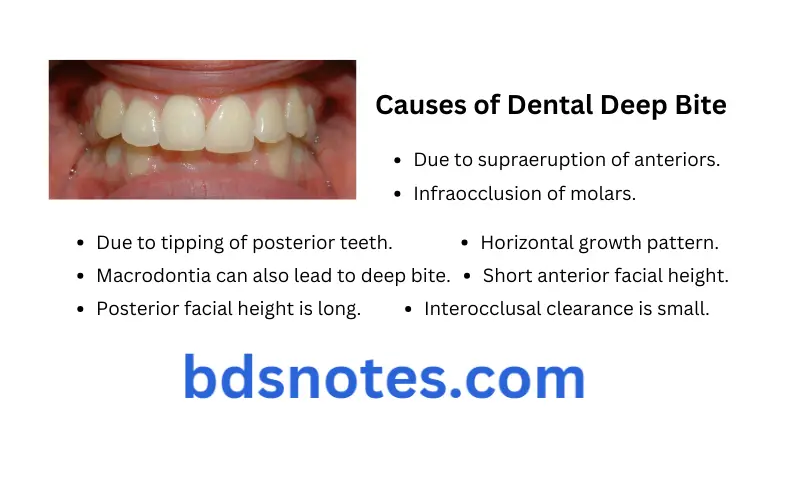
Causes of Dental deep bite
- Due to supraeruption of anteriors.
- Infraocclusion of molars.
- Due to premature loss of permanent teeth which leads to lingual collapse of anterior teeth.
- Due to tipping of posterior teeth.
- Macrodontia can also lead to deep bite.
- Horizontal growth pattern.
- Short anterior facial height.
- Posterior facial height is long.
- Upper facial height to lower facial height decreases.
- Interocclusal clearance is small.
“Common challenges in managing open bite and deep bite effectively: FAQs provided”
“Steps to explain different types of open bite: Anterior vs posterior: Q&A guide”
Treatment of Deep Bite
Deep bite is treated by using removable, fixed or the myofunctional appliances
Removable appliances
- Anterior bite plane is the most commonly used appliance for treating the deep bite.
- Anterior bite plane is the modifid Hawley’s appliance with the flat ledge of an acrylic behind maxillary anteriors.
- As patient bites, mandibular incisors contact the bite planeand disclose the posteriors which are free to erupt.
- Height of anterior bite plane is just enough to separate the posteriors by 1.5 to 2 mm as posterior teeth erupts the height of bite plane increases.
“Role of skeletal vs dental causes in open bite and deep bite: Questions answered”
Myofunctional Appliances
- Deep bite due to the infra-occlusion of molars can be treated by using the activator or the bionator.
- Design of the functional appliance is modified to allow extrusion of posterior teeth.
Fixed Appliances
Fixed orthodontic appliances may be used to intrude the anterior teeth
Anchor Bends
- Anchorage bends should be given in arch wire mesial to the molar tubes so the anterior part of arch wire lies gingival to the bracket slot.
- When the arch wires are pulled occlusally and engaged inside the brackets, a gingivally directed intrusive force is exerted on the incisors, which decreases the deep bite.
“Early warning signs of untreated open bite and deep bite: Common questions”
Arch Wires with Reverse Curve of Spee
- They intrude the anterior teeth.
- When there wires are inserted in molar tubes, anterior segment curves gingivally.
- Anterior segment is forced occlusally inside the bracket slot resulting in an intrusive force on incisors.
Use of Intrusion Arches
- Intrusion arch consists of two posterior stabilizing units in buccal segments which are made up of .0175 × .025 inch stainless steel wire.
- Anterior segment which consists of incisors is given a segmental wire of similar diameter.
- Intrusion arch is cantilever types of spring which is inserted into the auxiliary tube of molar tube and bypasses the premolars and the canines.
- It should given a 30 degree bend anterior to molar tube so that its anterior segment lies passively at depth of vestibule.
- Anterior segment is brought down incisally and is tied to anterior segment arch wire which causes intrusion of anteriors.
“Asymptomatic vs symptomatic effects of ignoring open bite and deep bite: Q&A”
Role of Headgears in Treatment of Deep Bite
- Deep overbite due to overeruption of maxillary anterior teeth and be corrected by high pull headgear attached to the anterior segment of arch wire in attempt to intrude these teeth.
- Cervical headgear with downward vector if force increase lower facial height by extruding the molars.
Temporary Anchorage Device or Mini Screws in Treatment of Deep Bite
- Maxillary incisors are intruded by placing temporary anchorage devices or mini screws between upper lateral incisors and canines.
- Placement of these mini screws is delayed till leveling and alignment is complete to enable the adequate interradicular bone at the site of their placement.
Leave a Reply