X-Ray Films And Accessories
Write short note on intensifying screen.
or
Write short note on composition and function of intensifying screen.
Answer.
Intensifying Screen
- Intensifying screen is a device that transfers X-ray energy into visible light; the visible light, in turn exposes the screen film.
- These screens intensify the effect of X-rays on the film, so less radiation is required to expose a screen film, and hence the patient is exposed to less radiation.
- In extraoral radiography, a screen film is sandwiched between the two intensifying screens of matching size and secured in a cassette.
- An intensifying screen is a smooth plastic sheet coated with minute fluorescent crystals called as phosphors. When exposed to X-rays, the phosphors fluoresce and emit visible light in the blue or green spectrum, the emitted light then exposes the film.
“What are X-ray films and accessories? A question and answers guide”
- Combination of X-ray film with an intensifying screen results in an image receptor system which is 10–60 times more sensitive to X-rays than the film alone. Thus, the duration of exposure is reduced, the contrast is improved and radiation back scatter minimized. Intensifying screen also reduces the patient dose by 85 to 90%.
Read And Learn More: Oral Radiology Question And Answers
“Understanding the role of X-ray films in diagnostic imaging: Q&A explained”
Intensifying Screen Composition
- Base: It is made of either a stiff sheet of cardboard or polyester plastic material. It is about 0.25 mm thick. The base is the supporting component of the screen.
- Reflecting layer: This is a thin layer of white material, i.e. magnesium oxide or titanium dioxide between the base and the luminescent layer. It serves to redirect to the film a large fraction of the emitted visible light which is moving away from the film and which would therefore otherwise be lost. So, it increases the sensitivity but some degree of unsharpness is created because of divergence of light reflected back to the film.
“Importance of studying X-ray films and accessories for better imaging outcomes: Questions explained”
- Phosphor layer: This layer consists of light sensitive phosphor crystals suspended in a plastic material. When these crystals are struck by photons they fluoresce, i.e. they emit visible light photons which expose the X-ray film.
- Coat: This layer protects the phosphor layer from mechanical insult such as abrasion, scratching, etc.
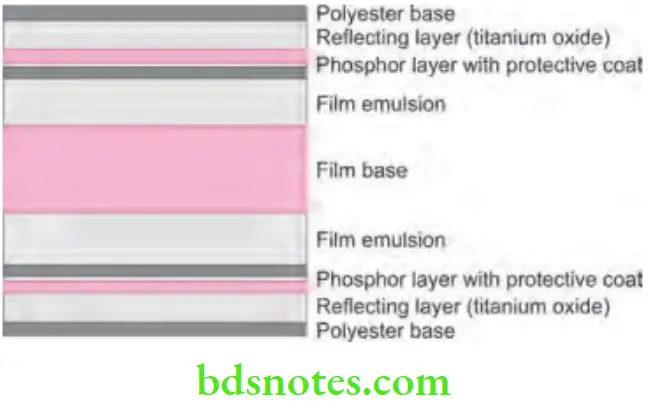
“Common challenges in using X-ray films and accessories effectively: FAQs provided”
Intensifying Screen Functions
- Intensifying screens are used in all extraoral radiography. They are used inside a cassette on both sides.
- Intensifying screens are not used in intraoral radiography. Screens are used in intraoral radiography in endodontics.
- Rare earth screens are four times much better than calcium screen.
“Steps to explain types of X-ray films: Screen vs non-screen films: Q&A guide”
- Intensifying screens reduces duration of exposure, improves contrast and minimize radiation back scatter.
- Intensifying screen also reduces the patient dose by 85 to 90%.
- Intensifying screen reduces tube and generator loading.
- Intensifying screen also reduces patient motion artifacts.
Leave a Reply