Yolk Sac Formation In Early Embryo: Simplified For Students
Question 1. Yolk sac
Answer:
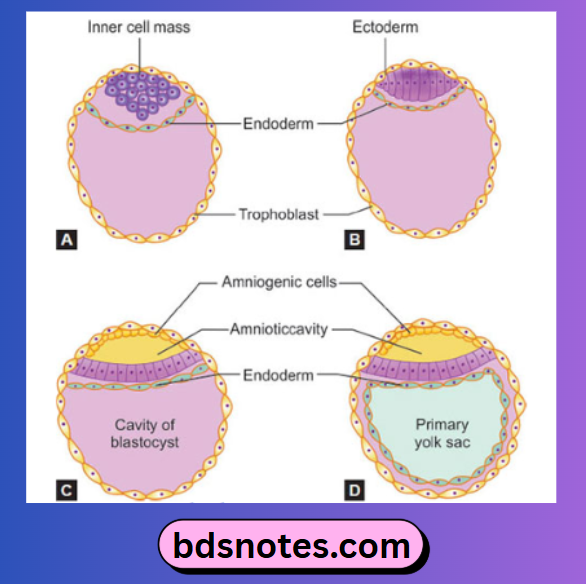
- As the fluid from the uterine cavity enters morula, it gets converted to blastocyst The outer layer of it is formed by trophoblast and inner layer by inner cell mass
- Some of the inner cell mass layer cells become flattened – these are called hypoblast
- Remaining cells become columnar to form epiblast
- The space between epiblast and hypoblast is called amniotic cavity
- Flattened cells from hypoblast spread and line blastocytic cavity and form primary yolk sac
- After formation of extra-embryonic coelom, the yolk sac becomes smaller and lined by cubical cells and form secondary yolk sac
Question 2. Effects of fertilization:
Answer:
Effects of fertilization Fertilization:
- It is the process by which male and female gametes fuse is known as fertilization.
- Site: In the ampullary region of the uterine tube.
- Effects:
- Binding of sperm to zona pellucid of the ovum.
- Penetration of the sperm through the zona pellucida
- Fusion of the cell membranes of the sperm and the ovum.
- Release of acrosomal enzymes.
- Prevention of entry of other spermatozoon into the oocyte.
- Metabolic changes within the ovum.
- The diploid chromosome number is restored.
- Sex determination takes place.
Leave a Reply