Waste Management
Question 1. Write a short note on solid waste disposal.
Or
Describe various methods for the disposal of solid waste.
Or
Write a short note on the methods of disposal of solid waste.
Answer: The following are the methods of disposal of solid waste:
- Dumping
- Controlled tipping or sanitary landfills
- Incineration
- Composting
- Manure pits
- Burial.
“Understanding waste management: Goals and applications”
Dumping
- Refuse is dumped in low-lying areas.
- This is the easy method for the disposal of dry refuse.
- This method is suitable for the reclamation of the land.
- As a result of bacterial action, refuse decreases in volume and is converted into humus.
Controlled Tipping
- It is the most satisfactory method of refuse disposal where suitable land is available.
- The material is placed in a trench or other prepared area and covered with earth at the end of the working day.
- Three methods are used:
- Trench method.
- Ramp method.
- Area method.
- Trench method: This method is used where level ground is available. A long trench is dug out 6 to 10 feet deep and 12-36 feet wide, depending on the local conditions. The refuse is compacted and covered with excavated earth.
- Ramp method: It is used where the terrain is moderately sloping. Some excavation is done to secure the covering material.
- Area method: This method is used for filling land depressions. Refuse is deposited and is sealed on its exposed surface with a mud cover. The method has the disadvantage of requiring supplemental earth from outside sources.
Chemical, physical, and bacteriological changes can take place in burial refuse.
“Importance of waste management in reducing pollution”
Read And Learn More: Public Health Dentistry Question And Answers
Incineration
- In this method, refuse is disposed of hygienically by burning or incineration.
- In this method, suitable land is not available.
- Hospital refuse is best disposed of by this method.
- It has limited application in refuse disposal.
“Common challenges in implementing effective waste management systems”
Composting
- It is the method of combined disposal of refuse and night soil, and sludge.
- It is a process of nature whereby organic matter brakes down under bacterial action resulting in the formation of the humus like material called as compost which has considerable manorial value for soil.
- Two methods are used:
- Bangalore Method (Anaerobic method)
- Mechanical Method (Aerobic method).
“Comparison of single-stream vs multi-stream recycling systems”
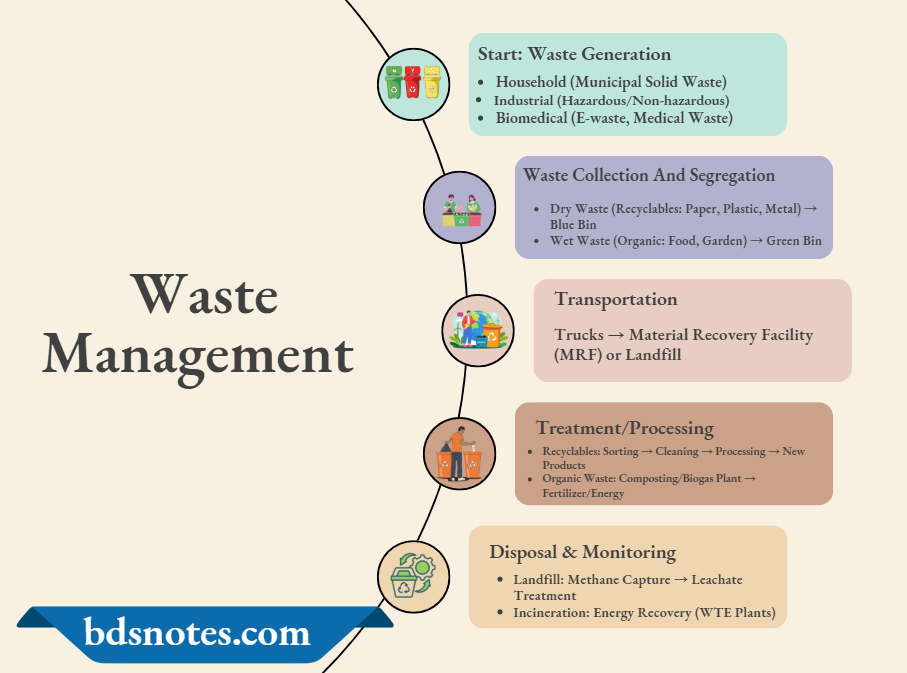
“Treatment options for hazardous waste in industries”
Bangalore Method
- In this method, trenches are dug depending on the amount of refuse to be disposed of.
- Depth should not be more than 3 ft because of slow decomposition.
- Pits should be located 800 m away from city limits.
- In this method the layer of refuse is spread at the bottom of trench and then night soil is added.
- Then alternate layers of refuse and night soil are added till the heap rises 1ft above the ground level.
- Top layer should be of refuse at least 9 inches in thickness. Then heap is covered with excavated earth and is compacted.
- Within a week, due to bacterial action, considerable heat is generated over a compost mass.
- This intense heat, which persists over 2 to 3 weeks, leads to the decomposition of material.
- At the end of 6 months, decomposition is complete.
Mechanical Method
- In this, compost is manufactured on a large scale.
- Refuse is first cleared of salvageable materials such as rags, bones, metal, glass, etc., which interfere with grinding.
- It is then pulverized in pulverizing equipment to reduce the size of particles to less than 2 inches.
- Pulverized refuse is then mixed with sewage, sludge, or nightsoil in the rotating machine and incubated.
- The whole process of composting finishes in 4 to 6 weeks.
Manure Pits
- This method is used in rural areas.
- The disposal can be done by digging manure pits by the individual householders.
- The garbage, cattle dung, straw and leaves should be dumped into the manure pits and are covered with the earth.
- In a duration of 4 to 6 months, the refuse is converted to manure, which is returned to the field.
- It is an effective and simple method in rural communities.
Burial
- This method is suitable for small camps.
- A trench 1.5 m wide and 2 m deep is excavated, and at the end of each day, the refuse is covered with 20 to 30 cm of earth.
- As the level of trench reaches 40 cm from ground level, the trench should be filled with earth and compacted and new trench is dug.
“Role of incineration in managing medical waste”
Question 2. Write a short note on the disposal of hospital waste.
Or
Write a short note on hospital waste management.
Or
Write a short answer on hospital waste management.
Answer. Hospital waste is defined as all the waste generated by health care establishments, research facilities, and laboratories.
Procedure of Disposal of Hospital Waste
The procedure involves handling, storage, and transportation:
- Color-coded plastic bags or containers should be used for the identification of waste.
- Sharps should be collected in container and the container should be puncture proof, rigid, impermeable, tamperproof and with covers.
- Bags and containers for infectious waste should be marked.
- Highly infectious waste should preferably be packed into red bags and sterilized immediately by autoclaving.
- Bags should be tightly closed or sealed.
- Waste should be stored in a separate area.
- Waste should be transported using wheeled trolleys, containers, or carts that are not used for any other purposes.
The following are the methods for the disposal of hospital waste:
- Incineration
- Chemical disinfection
- Wet thermal treatment
- Microwave irradiation
- Encapsulation
- Safe burying
- Inertization
Incineration
- Incineration is a high temperature dry oxidation process that reduces organic and combustible waste to inorganic and result in a very significant reduction of waste volume and weight.
- This process is usually used to treat wastes that cannot be recycled or reused.
- The incineration process consists of:
- A furnace or combustion chamber is maintained at over 120° Celsius.
- A platform for tipping the refuse.
- Stokers for ranking the refuse forward.
- Baffle plate to drive out all fumes.
- Rotary kilns: Incineration is done by the use of various incinerators, i.e., double chamber pyrolytic incinerator, single chamber furnace with static grate, and Rotary kilns
Chemical Disinfection
- In this method, chemicals are added to kill or deactivate pathogens.
- This method is used for highly hazardous health care wastes, which are disinfected chemically but under limitations.
Wet Thermal Treatment
- It is also known as steam disinfection.
- In this shredded infectious waste is exposed to high temperature and high-pressure steam.
Microwave Irradiation
- By this method the water contained in the wastes is rapidly heated by microwaves and infectious components are destroyed by conduction of heat.
- Microwaves of frequency 2450 MHz and wavelength of 12.24 cm are used.
Encapsulation
- In this method, containers are used that are made up of high-density polyethylene or metal drums for waste.
- Such containers are filled with a medium consisting of immobilizing material such as plastic foam or clay.
- As the medium gets dry, the containers are sealed off and disposed of in landfill sites.
Safe Burying
- In this method, only hazardous health care waste should be buried.
- Chemical waste should not be buried.
- The burial site should be covered by the earth to prevent health hazards
Inertization
- In this process, waste is mixed with cement or other substances before disposal.
- Mixing with cement is done to avoid the toxic substances of waste to migrate in surface water or ground water.
“Follow-up care after implementing waste management programs”
Question 3. Write a short note on the disposal of waste.
Or
Write a short note on waste disposal.
Answer. Waste: Unwanted or discarded material from houses, streets, sweeping, commercial, industrial, and agricultural operations, arising from man’s activities.
- In cities it is called refuse, in the country site it is called liter and in general it is called solid waste.
- Waste disposal consists of the disposal of solid waste and the disposal of healthcare waste.
Question 4. Write a short note on the disposal of waste in a dental clinic.
Answer. Dental Clinics generate a number of infectious andhazardous wastes that can be harmful to the public and health care workers.
Classification of Dental Clinics’ Waste Products
Dental biomedical wastes that are considered hazardous are as follows:
- Mercury-containing wastes.
- Elementary amalgam
- Scrap amalgam.
- Silver-containing wastes.
- Spent X-ray fixer
- Undeveloped films.
- Lead-containing wastes.
- Lead aprons
- Lead foil packets.
- Chemical wastes.
- Disinfectants
- Sterilizing agents
- Laboratory reagents.
- Biomedical wastes.
- Sharps
- Anatomical biomedical wastes (human tissues)
- Non-anatomical biomedical wastes (Blood/saliva-soaked materials).
Disposal of Dental Clinics’ Waste Products
Segregation of the Waste Products
- Ideally, segregation should occur as close as possible to the point of origin.
- Separate the wastes in appropriately color-coded containers to facilitate treatment, transport, and further disposal.
- General waste is separated into organic waste that can be composted and recyclable.
- Biomedical waste must be segregated into infectious sharps, infectious non-sharp wastes, soiled wastes, and solid waste.
Storage
Separate and secure areas must be kept for the storage of segregated biomedical wastes. Biomedical wastes must not be stored for more than 48 hours.
Transportation
- Within the clinic, closed trolleys or wheeled containers with appropriate markings must be used.
- Off-site transport-special vehicles with a fully enclosed body lined with stainless steel or aluminium to provide a smooth area and impervious surface for easy cleaning.
Disposal
Disposal options include:
- Municipal dump: Usually open dumps where waste is deposited in a scattered and uncontrolled way.
- Sanitary landfill: Designed and constructed to prevent the contamination of soil and surface and groundwater, to limit pollution smells, and direct contact with the public.
- Incineration: Sharp needles and other sharp instruments are destroyed by an incinerator in a dental clinic.
“Complications of ignoring proper waste management practices”
Question 5. Write a short note on the Bangalore method of waste disposal.
Or
Write a short answer on the Bangalore method of waste disposal.
Answer:
- Bangalore method is also known as the anaerobic method.
- Bangalore method of waste disposal is one of the types of method of composting.
The following processes are followed in the Bangalore method:
- In this method, trenches are dug depending on the amount of refuse to be disposed of.
- Depth should not be more than 3 feet because of slow decomposition.
- Pits should be located 800 m away from city limits.
- In this method, the layer of refuse is spread at bottom of trench and then the night soil is added.
- Then alternate layers of refuse and night soil are added till the heap rises 1 ft above the ground level.
- Top layer should be of refuse at least 9 inches in thickness. Then heap is covered with excavated earth and is compacted.
- Within a week, due to bacterial action, considerable heat is generated over a compost mass.
- This intense heat, which persists over 2 to 3 weeks, leads to the decomposition of the material.
- At the end of 6 months, decomposition is complete.
“Techniques for managing high-risk waste streams”
Question 6. Write briefly on environmental health.
Or
Write a short note on environmental health.
Answer. The term environmental sanitation is now being replaced by environmental health.
- Environmental sanitation is defined as “the control of all those factors in man’s physical environment which exercise or may exercise a deleterious effect on his physical development, health and survival,” WHO
- Proper environmental health now requires the services of the public health qualified doctor, the epidemiologist, the public health engineer, the town planner, the sociologist, the economist, and the health inspector.
- The purpose of environmental health is to create and maintain ecological conditions that will promote health and thus prevent disease.
- Two of the changes needed to achieve “Health for All” are concerned with a healthy environment and healthy lifestyle initiatives by the individual, the family and the community.
- Much of the ill-health in India is due to poor environmental sanitation, i.e., unsafe water, polluted soil, unhygienic disposal of human excreta and refuse, poor housing, insects, and rodents.
- Air pollution is also a growing concern in many cities. The high death rate, infant mortality rate, sickness rate and poor standards of health are in fact largely due to defective environmental sanitation.
Environmental Sanitation as a Cultural Factor in Health and Disease
- Disposal of Human Excreta: A Large percentage of people in rural areas use open fields for defecation. This practice is time-honoured and is considered harmless in villages. The average Indian villager is averse to the idea of latrines. He considers that latrines are meant for city dwellers, where there are no fields for defecation. He is ignorant that feces are infectious and pollute water and soi,l and promote fly breeding. Thus, the problem of excreta disposal is bound up with numerous beliefs and habits based on ignorance.
- Disposal of Wastes: The average villager is not aware that mosquitoes breed in collections of wastewater. It is permitted to flow into the streets. The solid waste (refuse) is invariably thrown in front of the houses, where it is permitted to accumulate and decompose. Periodically, it is removed to the fields and used as manure. The animal dung (cow dung) is allowed to accumulate. It is used sometimes as manure and often pressed into cakes, sun-dried, and used as fuel.
- Water Supply: The well occupies a pivotal place in the cultural environment of villages. It is also a common meeting place of men and women of the village when they go to draw their supply of water. It is a place where people bathe and wash their clothes. It is a place where animals are washed and given a drink. These cultural practices lead to the pollution of well water. Tanks and ponds are used for washing, bathing, ablution, and sometimes even as a source of drinking water. Some rivers are considered “holy”. People go on pilgrimage to these rivers to have a dip.
- They not only have a dip but also drink the raw water, which they consider sacred. Samples of ‘holy water’ are bottled and carried over long distances for distribution among friends and relatives. Epidemics of cholera and gastroenteritis have been due to these cultural practices. Step wells are associated with guinea worm disease.
- Housing: Rural houses are practically the same all over the country. They are usually katcha and damp, ill-lighted and ill-ventilated. For reasons of security, no windows are provided, and if at all, one is provided, it is merely a small hole. Absence of a separate kitchen, latrine, bathroom, and drainage is the characteristic feature of an average rural house. Animal keeping is very common in villages. Infrequently, human beings and animals live under one roof. Houses are generally kept clean inside, regularly whitewashed or plastered with mud and cow dung.
Environmental Sanitation as a Measure for Health Protection of Workers
Within the industrial establishment, the following needs attention for the prevention of the spread of communicable diseases by water, food, or other means:
- Water Supply: A sufficient supply of wholesome drinking water is the basic requirements in all industrial establishments. The common glass tumbler for drinking water should be abandoned as it spreads infection. Installation of drinking water fountains, at convenient points should always be encouraged.
- Food: If food is sold, its sanitary preparation, storage, and handling should be essential. Education of food handlers and other measures may be necessary to prevent outbreaks of gastrointestinal disease.
- Toilet: There should be sufficient number of latrines and urinals of the sanitary type, separate for males and females, conveniently situated. It is recommended that there should be at least one sanitary convenience for every 25 employees (males and females separate) for the first 100 employees, and thereafter one for every 50. Garbage and waste disposal should be such as to avoid the breeding of flies and vermin.
- General Plant Cleanliness: The walls, ceilings, and passages should be painted with water washable paint and repainted at least once in 3 years and washed at least once every 6 months. The dust that settles down on the floor and machinery should be promptly removed by vacuum cleaners or by wetting agents before it is redistributed into the atmosphere by the vibration of the machinery or buildings. A high standard of general cleanliness is one of the fundamentals of accident Prevention. It also contributes to the efficiency and high morale of the workers.
- Sufficient Space: Sufficient floor space and cubic space are essential to prevent not only respiratory infections but also to ensure a comfortable working environment. The recommended standard is a minimum of 500 Cu. ft. of space for every worker; space more than 14 feet above the floor level is not to be taken into consideration.
- Lighting: The results of poor industrial illumination are workers’ eye fatigue, increased accidents, decreased production, and more rejections of finished products. Furthermore, defective illumination over a long period may result in permanent impairment of vision. There should be sufficient and suitable lighting, natural or artificial or both, in every part of a factory where workers are working or passing through. The standards of illumination for different kinds of work have been set out. Precision work for a high degree of accuracy may require 50-75 foot candles; where people work regularly, 6 to 12 foot candles may be sufficient. Illumination in corridors and passages should be at least 0.5 foot candles.
- Ventilation, Temperature: Poor ventilation not only increases the chances of infection from person to person, but also affects the mental and physical efficiency of the workers. Proper ventilation is also needed for the control of noxious vapours, fumes, and dusts, and prevention of fatigue and industrial accidents. Effective and suitable provision should be made for maintaining adequate ventilation by circulation of fresh air in every work room, and such a temperature that will secure to workers therein, reasonable conditions of comfort and prevent injury to health.
- Protection against Hazards: There should be adequate environmental controls designed to protect the workers against exposure to dusts, fumes and other toxic hazards.
- Housing: There is usually an acute shortage of housing in industrial areas. Most workers come from rural areas. The housing of workers near a plant must be correlated to essential community amenities and social and sanitary facilities. Town planning and zoning are highly desirable.
Leave a Reply