• Skip to main content
  • Skip to secondary menu
  • Skip to primary sidebar
  • About Us
  • Terms of Use
  • Privacy Policy
  • Disclaimer
  • Contact Us
  • Sitemap

BDS Notes

BDS notes, Question and Answers

  • Public Health Dentistry
  • Periodontics
  • Pharmacology
  • Pathology
  • Orthodontics
    • Anchorage In Orthodontics
    • Mandibular Growth, Functional Matrix
    • Retention and Relapse
  • General Surgery
    • Cysts: Types, Causes, Symptoms
    • Maxillofacial Fractures, Disorders, and Treatments
    • Lymphatic Disorders
    • Neurological and Facial Disorders
  • Temporal And Infratemporal Regions
    • Spinal and Neuroanatomy
  • Dental Materials
    • Dental Amalgam
Home » Understanding The Dental Pulp: Odontoblast Layer, Pulpitis, And Treatment Considerations

Understanding The Dental Pulp: Odontoblast Layer, Pulpitis, And Treatment Considerations

February 5, 2026 by Kristensmith Taylor Leave a Comment

Understanding The Dental Pulp: Odontoblast Layer, Pulpitis, And Treatment Considerations

Question 1. Odontogenic zone of pulp.
Answer:
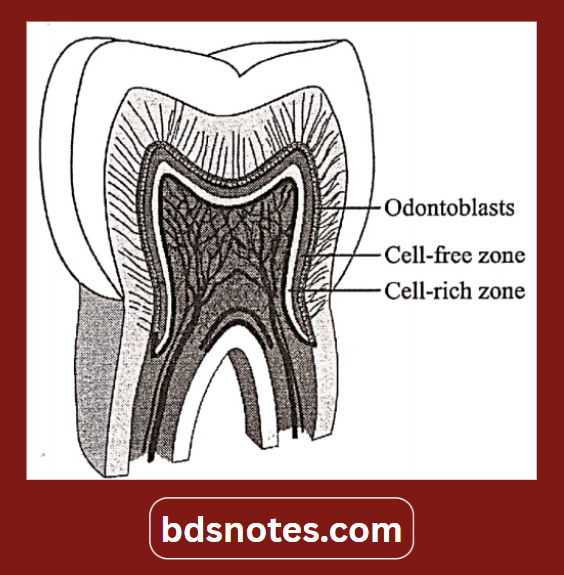
Odontoblast Layer Structure

Question 2. Age changes and clinical considerations of the pulp.
Answer:

Clinical considerations:

  • Pulpitis- It is a pulpal response to trauma occurring due to bacterial infection or physical trauma.
  • Pulpitis can be focal reversible pulpitis which is of milder form or chronic hyperplastic pulpitis characterized by an exposed pulp chamber with a protruding mass of granulation tissue.
  • Inflammation occurring within the pulp called internal resorption results in pulpal tissue appearing pink through the enamel (pink tooth).
  • A pulpal infection can spread and result in granulomas, abscesses, and cysts.
  • The shape of the pulp chamber and pulpal horns is to be considered before any dental procedures.
  • The shape of the apical foramen, its size, presence, and absence of accessory canals affect the root canal treatment.
  • Periodontol disease has an impact on the pulp.
  • Pulp pain worsens with the degree of inflammation.
  • A vital pulp is essential for good dentition.
  • In response to orthodontic forces, the pulp shows cell damage, inflammation, vasodilation, and healing.

Filed Under: Anatomy

Reader Interactions

Leave a Reply Cancel reply

Your email address will not be published. Required fields are marked *

Primary Sidebar

Recent Posts

  • Branchial Cleft Cyst: Background, Pathophysiology, Etiology
  • Maxillary Nerve: Origin, Course, And Branches
  • The Father Of Anatomy And A Great Anatomist Herophilus
  • Bone Structure – Anatomy
  • The External Carotid Artery: Anatomy, Branches, And Functions
  • Occipitofrontalis Muscle
  • Superficial Temporal Artery
  • Platysma Muscle
  • Cartilage
  • Cauda Equina And Conus Medullaris Syndromes
  • Subcutaneous Injections And Device Management
  • Types Of Circulation: Pulmonary, Systemic, And Portal
  • Structure Of Skeletal Muscle
  • Elastic Cartilage
  • Cellular Organelles And Structure
  • The Golgi Apparatus – The Cell
  • The Cytoplasmic Inclusions Of Certain Plant Cells
  • Dental Abscess
  • Laser Surgery
  • Our Facial Muscles And Their Functions

Copyright © 2026 · Magazine Pro on Genesis Framework · WordPress · Log in