• Skip to main content
  • Skip to secondary menu
  • Skip to primary sidebar
  • About Us
  • Terms of Use
  • Privacy Policy
  • Disclaimer
  • Contact Us
  • Sitemap

BDS Notes

BDS notes, Question and Answers

  • Public Health Dentistry
  • Periodontics
  • Pharmacology
  • Pathology
  • Orthodontics
    • Anchorage In Orthodontics
    • Mandibular Growth, Functional Matrix
    • Retention and Relapse
  • General Surgery
    • Cysts: Types, Causes, Symptoms
    • Maxillofacial Fractures, Disorders, and Treatments
    • Lymphatic Disorders
    • Neurological and Facial Disorders
  • Temporal And Infratemporal Regions
    • Spinal and Neuroanatomy
  • Dental Materials
    • Dental Amalgam
Home » Understanding Reticulocytes And The Immune System

Understanding Reticulocytes And The Immune System

February 6, 2026 by Kristensmith Taylor Leave a Comment

Understanding Reticulocytes And The Immune System

Question 1. Reticulocyte.
Answer:

Reticulocyte Synonym:

  • Immature RBC.
  • Size: 7-8 mm

Reticulocyte Structure:

  • Nucleus is not present
  • It contains remnants of RNA.
  • Cytoplasm contains reticular network of disintegrated organelles.
  • It is basophilic due to the presence of remnants of golgi apparatus, mitochondria and other organelles.

Reticulocyte Count:

  • 2-6% in newobron.
  • Decreases after first week.
  • Remains constant at or below 1% – later.
  • Increases when RBC production increases.

Question 2. Types of immunity.
Answer:

1. Innate immunity:

  • It is inborn capacity of body to resist against diseases caused by pathogens.
  • It is present at birth.
  • Whenever any pathogens enters the body, it eliminates them before they cause any disease.

2. Acquired immunity:

  • It is the resistance development by the body against any specific foreign body.
  • It is also called specific immunity.
  • Lymphocyte plays an important role in it.
  • This is again of two types.
    1. Cellular immunity:
      • It is responsible for delayed allergic reaction and rejection of transplants.
      • It is mediated by T-lymphocytes.
      • It is the major defence against infections caused by fungi, virus and bacteria.
      • It also helps in defense against tumours.
    2. Humoral immunity:
      • It is mediated by B-lymphocytes.
      • It activates the complement system to neutralize antigens.
      • It is major defense against bacterial infection

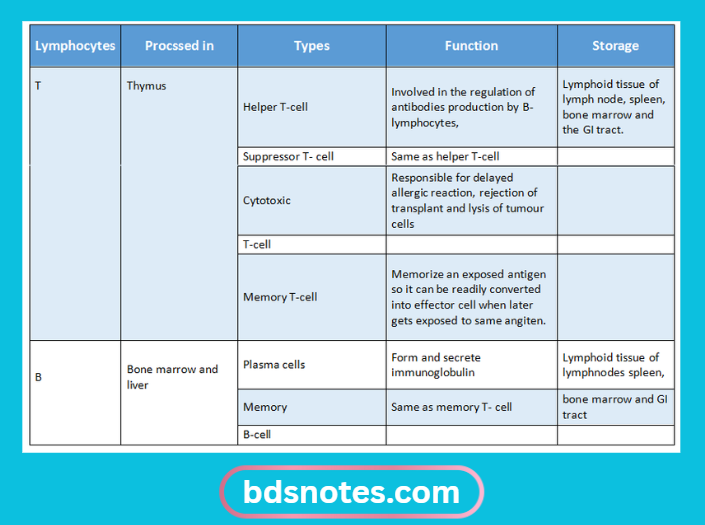
Question 3. Lymphocytes.
Answer:

Lymphocytes Types Functions

Filed Under: Anatomy

Reader Interactions

Leave a Reply Cancel reply

Your email address will not be published. Required fields are marked *

Primary Sidebar

Recent Posts

  • Branchial Cleft Cyst: Background, Pathophysiology, Etiology
  • Maxillary Nerve: Origin, Course, And Branches
  • The Father Of Anatomy And A Great Anatomist Herophilus
  • Bone Structure – Anatomy
  • The External Carotid Artery: Anatomy, Branches, And Functions
  • Occipitofrontalis Muscle
  • Superficial Temporal Artery
  • Platysma Muscle
  • Cartilage
  • Cauda Equina And Conus Medullaris Syndromes
  • Subcutaneous Injections And Device Management
  • Types Of Circulation: Pulmonary, Systemic, And Portal
  • Structure Of Skeletal Muscle
  • Elastic Cartilage
  • Cellular Organelles And Structure
  • The Golgi Apparatus – The Cell
  • The Cytoplasmic Inclusions Of Certain Plant Cells
  • Dental Abscess
  • Laser Surgery
  • Our Facial Muscles And Their Functions

Copyright © 2026 · Magazine Pro on Genesis Framework · WordPress · Log in