Understanding Red Blood Cells: Shape, Size and Function
Describe the morphology of red blood cells.
Answer:
Morphology of red blood cells:
- Morphology of red blood cells Shape:
- It has disk-shaped and biconcave structure.
- This structure has following advantages.
- Helps in easy and quick exchanges of gases.
- Allows easy folding of RBC on itself when it passes through capillaries.
- Allows consideration alteration in cell volume to withstand considerable changes in pressure.
- Provides large surface area for absorption or removal of different substances.
- Morphology of red blood cells Size:
- Diameter -7.2 μ
- thickness-2.2 μ at periphery, 1 μ at center.
- Surface area – 120 sqm.
- Volume-85-90 cu.m.
- Morphology of red blood cells Structure:
- RBC is a non-nucleated cell.
- DNA and mitochondria are absent.
- Golgi apparatus is also absent.
- Energy is produced from glycolytic process.
- RBC contains cytoskeleton made up of actin and spectrin.
- Both these proteins are anchored to transmembrane protein by ankyrin.
- RBC cell membrane contains circular pores below which contractile protein spectrin lies.
- Spectrin maintains shape and flexibility of RBC and contains antigen.
- Morphology of red blood cells Count:
- At birth-6-7 million/μL
- Adult: Male – 5-6 million/μL, female – 4.5-5.5 million/μL.
- Life span 120 days after which it is destroyed by tissue macrhophage system.
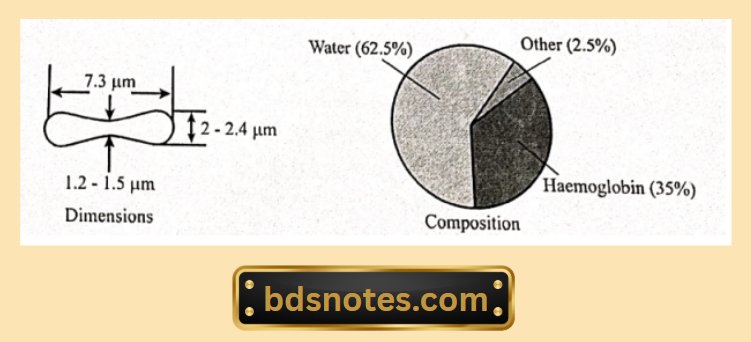
Morphology of red blood cells Composition:
- Water 62.5%
- Hemoglobin – 35%
- Organic substances – 2.5%
- This includes sugar, lipids, protein and enzymes.
Leave a Reply