Understanding Pulp Stones: A Complete Guide for Dental Students
Pulp classifications
Answer:
- Calcifications within pulp are called pulp stones.
- They are modular, discrete calcified masses that have a calcium-phosphorous ratio comparable to that of dentin.
- They may be single or multiple.
Site:
- They appear in either or both the coronal and root portions of the pulp.
- They may be seen in functional as well as embedded unerupted teeth.
- They are frequently found at the orifice of the pulp chamber or within the root canal.
Histology:
- They usually consist of concentric layers of mineralized tissue formed by surface accretion around blood thrombi, dying or dead cells, or collagen fibers.
- Occasionally a pulp stone may contain a tubule.
Types:
1. True pulp stones:
- They have dentinal tubules and odontoblastic processes.
- They occur most commonly close to the apex of the root.
False pulp stones:
- They do not have dentinal tubules.
- They appear as concentric layers of calcified tissue.
- They are common in the coronal pulp.
- They are formed around dead cells of collagen.
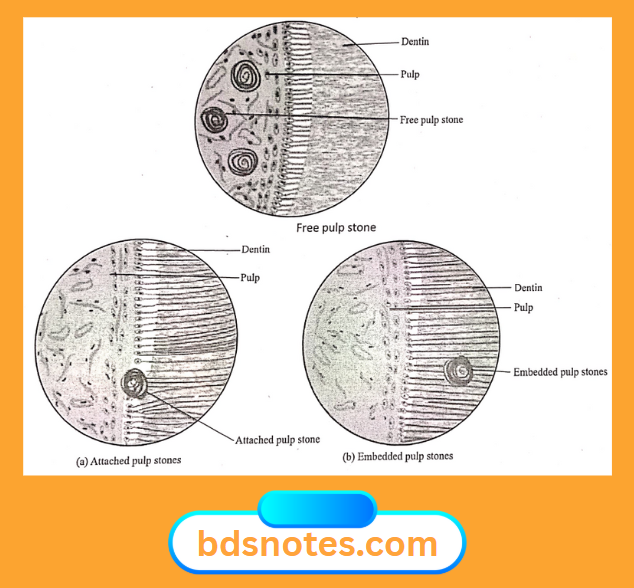
2. Free pulp stones:
- They are entirely surrounded by pulp tissue.
Attached are pulp stones:
- They are partly fused with dentin.
Embedded pulp stones:
- They are entirely surrounded by dentin.
Significance:
- The presence of pulp stones reduces the overall number of cells within the pulp.
- They play an important role in the debridement and enlargement of the root canal system during endodontic treatment.
Leave a Reply