Understanding Oral Habits And Their Role In Malocclusion
Write briefly on oral habits.
Answer.
Definition of Habits
- A habit can be defined as the tendency towards an act that has become a repeated performance, relatively fixed, consistent,t and easy to perform by an individual.
- Habit can be defined as “a fixed or constant practice established by frequent repetition.” —Dorland.
- Habit is a formed reaction that is resistant to change, whether useful or harmful, ul depending on the degree to which it interferes with a child’s physical, emotional, and social functions.
- Habits are learning muscular contractions, which are complex.
- A habit is an inclination or aptitude for some action acquired by frequent repetition and showing itself in increased facility to performance and reduced power of the resistance.
Classification of Habits
William James Classification
Useful and Harmful Habit
- Useful habits: These include habits that are considered essential for normal function, such as proper positioning of the tongue, respiration, and normal deglutition.
- Harmfuhabitsit: These include habits that have a deleterious effect on the teeth and their supporting structure, such as thumb sucking, tongue thrusting, etc.
Klein’s Classification
Empty and Meaningful Habit
- Empty habits They are habits that are not associated with any deep-rooted psychological problems.
- Meaningful habits They are habits that have psychological problems
Finn’s Classification
Compulsive and Noncompulsive Habits
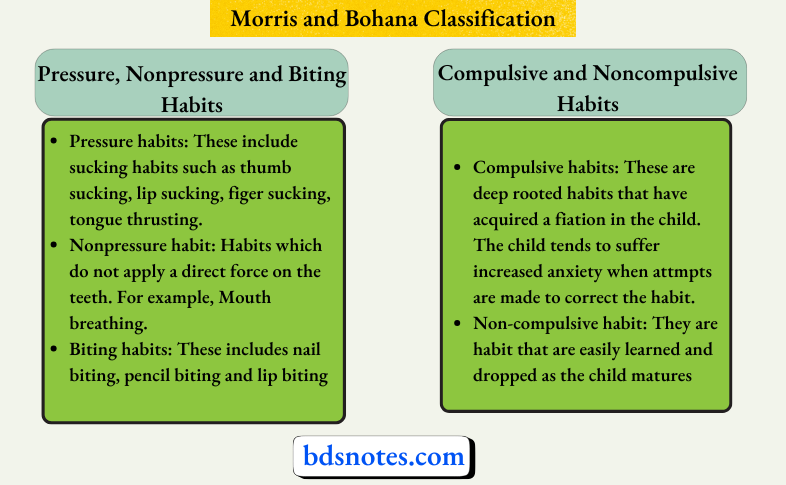
- Compulsive habits: These are deep-rooted habits that have acquired a fiation in the child. The child tends to suffer increased anxiety when attempts are made to correct the habit.
- Non-compulsive habits: They are habits that are easily learned and dropped as the child matures.
Kingsley Classification
Functional, Muscular, Combined Muscular and Postural Habits
- Functional habits: These include mouth breathing
- Muscular habits: Cheek and lip biting and tongue thrusting
- Combined muscular habits: It includes thumb and finger sucking
- Postural habits: Habits such as abnormal pillowing and chin propping
Pathophysiology of Oral Habits Causing Malocclusion
Tongue Thrusting Habit
Repeated anterior positioning ofthe tongue causes anterior open bite, protruded and spaced anterior teeth, and an incompetent anterior lip seal all these effects produce tongue thrusting.
Mouth Breathing Habit
- A child suffering from nasorespiratory blockage because of enlarged tonsils and recurrent throat infection, etc., keeps his/ her tongue low and forward and is unable to maintain anterior lip seal.
- These patients develop mouth breathing habits with open mouth posture. Such children develop long faces known as adenoid facies.
Thumb or Digit Sucking Habit
- Development of normal orofacial function is hampered due to the continuation of sucking habits beyond the age of 4 to 5 years.
- At the time thumb sucking or digit sucking, the mouth remains open,n and the tongue is positioned forward and low in the mouth, due to this, abnormal pressure is generated by the contraction of the cheek muscles, which produces an imbalance in the n the intraoral force system.
- Exaggerated buccinator activity at the time of sucking and swallowing produces constricted maxilla, buccal crossbite, and lower and backward mandibular posture causing Class II division 1 malocclusion.
Leave a Reply