• Skip to main content
  • Skip to secondary menu
  • Skip to primary sidebar
  • About Us
  • Terms of Use
  • Privacy Policy
  • Disclaimer
  • Contact Us
  • Sitemap

BDS Notes

BDS notes, Question and Answers

  • Public Health Dentistry
  • Periodontics
  • Pharmacology
  • Pathology
  • Orthodontics
    • Anchorage In Orthodontics
    • Mandibular Growth, Functional Matrix
    • Retention and Relapse
  • General Surgery
    • Cysts: Types, Causes, Symptoms
    • Maxillofacial Fractures, Disorders, and Treatments
    • Lymphatic Disorders
    • Neurological and Facial Disorders
  • Temporal And Infratemporal Regions
    • Spinal and Neuroanatomy
  • Dental Materials
    • Dental Amalgam
Home » Ugly Duckling Stage Simplified For Dental Students

Ugly Duckling Stage Simplified For Dental Students

February 9, 2026 by Kristensmith Taylor Leave a Comment

Ugly Duckling Stage Simplified For Dental Students

Write short note on ugly duckling stage of dentition.
Or
Write short note on Broadbent phenomenon.
Or
Write short note on ugly duckling stage.
Or
Write short answer on ugly duckling stage of occlusion. 
Or
Write short answer on ugly duckling stage.
Answer.
  • Ugly duckling stage is the transient form of malocclusion.
  • It is also known as Broadbent phenomenon or physiological midline diastema
  • It is known as ugly duckling stage since it represents a metamorphosis from an unaesthetic phase to an aesthetic phase.
  • Ugly duckling stage occurs from 7 to 11 years of age.
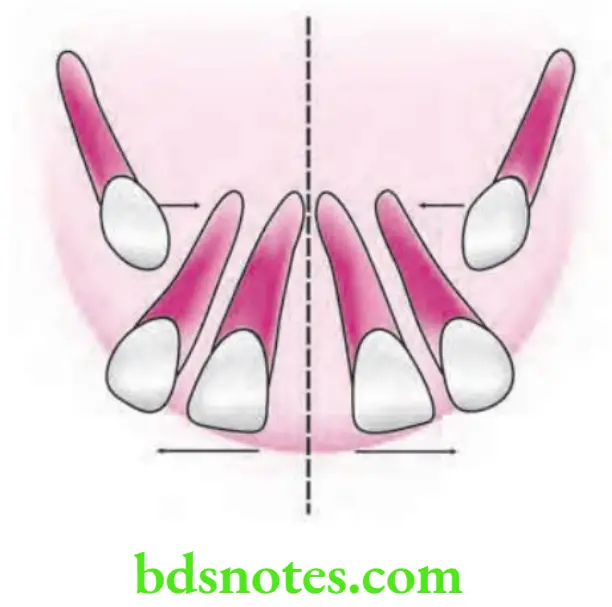
  • As the canine erupts they impinge over the roots of lateral incisors.
  • Erupting pressure of canines leads the lateral incisor to erupt in oral cavity with distal divergence of crown.
  • As the lateral incisor erupts completely the erupting pressure from the canine persist and is transmitted to central incisors which leads to the divergence of crown and convergence of roots towards midline.
  • This effect causes midline diastema, which is self corrected later on.
  • The temporary space which exists between central incisors and at times between central as well as lateral incisors closes spontaneously as canine come into occlusion. This is known as ugly duckling stage.
Clinical Importance
  • If attempt is made to close this diastema, deleterious effects occur, i.e. canine get deflected from its path of eruption and the apex of lateral incisor get damaged.
  • Total closure of diastema should not be done more than 2 mm.
Orthodontics Development Of Dentition And Occlusion Ugly Duckling Stage Of Definition

Filed Under: Orthodontics

Reader Interactions

Leave a Reply Cancel reply

Your email address will not be published. Required fields are marked *

Primary Sidebar

Recent Posts

  • Branchial Cleft Cyst: Background, Pathophysiology, Etiology
  • Maxillary Nerve: Origin, Course, And Branches
  • The Father Of Anatomy And A Great Anatomist Herophilus
  • Bone Structure – Anatomy
  • The External Carotid Artery: Anatomy, Branches, And Functions
  • Occipitofrontalis Muscle
  • Superficial Temporal Artery
  • Platysma Muscle
  • Cartilage
  • Cauda Equina And Conus Medullaris Syndromes
  • Subcutaneous Injections And Device Management
  • Types Of Circulation: Pulmonary, Systemic, And Portal
  • Structure Of Skeletal Muscle
  • Elastic Cartilage
  • Cellular Organelles And Structure
  • The Golgi Apparatus – The Cell
  • The Cytoplasmic Inclusions Of Certain Plant Cells
  • Dental Abscess
  • Laser Surgery
  • Our Facial Muscles And Their Functions

Copyright © 2026 · Magazine Pro on Genesis Framework · WordPress · Log in