Types Of Enzyme Inhibition
Describe competitive and non- competitive inhibition of enzymes with their examples.
Answer.
Competitive Inhibiton
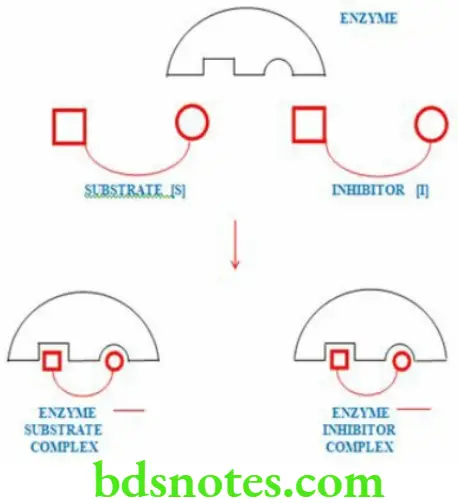
- When the active site of the enzyme is occupied by a substance other than the substrate of the enzyme, its activity is inhibited.
- This is known as competitive inhibition
- It is a reversible type of inhibition
- In competitive inhibition both ES and EI complexes are formed during the reaction
- The affinity of the substrate for the enzyme is progressively decreased with the increase in concentration of the inhibitor, thus lowering the rate of enzymatic reaction
- However, when the concentration of substrate is increased, the effect of inhibitor can be reversed, forcing it out of the EI complex
Clinical Importance Of Competitive Inhibitors
- Allopurinol
- Enzyme – Xanthine oxidase
- Substrate – Xanthine
- Inhibitor – Allopurinol
- Significance – Treatment of gout
- Amphetamine
- Enzyme – Monoamine oxidase
- Substrate – Epinephrine
- Inhibitor – Amphetamine
- Significance – To elevate catecholamine levels
Non Competitive Inhibition
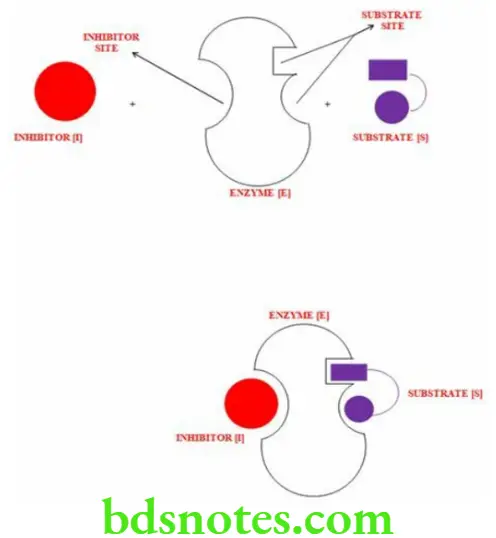
- This occurs when substances not resembling geometry of the substrate do not exhibit mutual competition.
- The sites of attachment of the substrate and inhibitor are different
- The inhibitor binds with a site on the enzyme other than the active site.
- The inhibitor may combine with both free enzyme and ES complex.
- There are 2 types of non competitive inhibition –
- Reversible
- Irreversible
- Reversible non competitive inhibition
- If the inhibitor can be removed from its site of binding without affecting the activity of the enzyme, it is called reversible non competitive inhibition.
- Example – heavy metal ions (lead, silver, mercury) inhibit enzymes by binding with the cysteinyl sulfhydryl groups.
- Irreversible non competitive inhibition
- If the inhibitor can be removed from the site of binding only with the loss of enzymatic activity, it is called irreversible non competitive inhibition
- Example – iodoacetate inhibits the enzyme glyceraldehyde 3-phosphate dehydrogenase
Leave a Reply