• Skip to main content
  • Skip to secondary menu
  • Skip to primary sidebar
  • About Us
  • Terms of Use
  • Privacy Policy
  • Disclaimer
  • Contact Us
  • Sitemap

BDS Notes

BDS notes, Question and Answers

  • Public Health Dentistry
  • Periodontics
  • Pharmacology
  • Pathology
  • Orthodontics
    • Anchorage In Orthodontics
    • Mandibular Growth, Functional Matrix
    • Retention and Relapse
  • General Surgery
    • Cysts: Types, Causes, Symptoms
    • Maxillofacial Fractures, Disorders, and Treatments
    • Lymphatic Disorders
    • Neurological and Facial Disorders
  • Temporal And Infratemporal Regions
    • Spinal and Neuroanatomy
  • Dental Materials
    • Dental Amalgam
Home » Types Of Embolism

Types Of Embolism

November 20, 2025 by Kristensmith Taylor Leave a Comment

Types Of Embolism

Question 1. Write a short note on types of embolism.
Answer:

Embolism is the process of partial or complete obstruction of some part of the cardiovascular system by any mass carried in circulation. The mass is called as embolus.

Emboli may be of Various Types

  • Depending upon the matter in the emboli:
    • Solid, For Example. detached thrombi
    • Liquid, For Example. fat globules
    • Gaseous, For Example. air.
  • Depending upon whether infected or not:
    • Bland, when sterile
    • Septic, when infected.
  • Depending on the source of emboli:
    • Cardiac emboli: From the left side of the heart. For Example. Emboli originating in the atrium and atrial appendages, infarct in the left ventricle, the vegetation of endocarditis.
    • Arterial emboli: For Example. In systemic arteries in the brain, spleen, kidney, and intestine.
    • Venous emboli: For Example. In pulmonary arteries.
    • Lymphatic emboli: It can also occur sometimes.
  • Depending upon the flow of blood:
    • Paradoxical embolism: An embolus that is carried from the venous side of the circulation to the arterial side or vice versa.
    • Retrograde emboli: An emboli which travel against the flow of blood is called a retrograde embolus.

Fat embolism vs air embolism

Types of embolism

Question 2. Write a short note on the pathogenesis of septic shock.
Or
Discuss the pathogenesis of septic shock.
Answer:
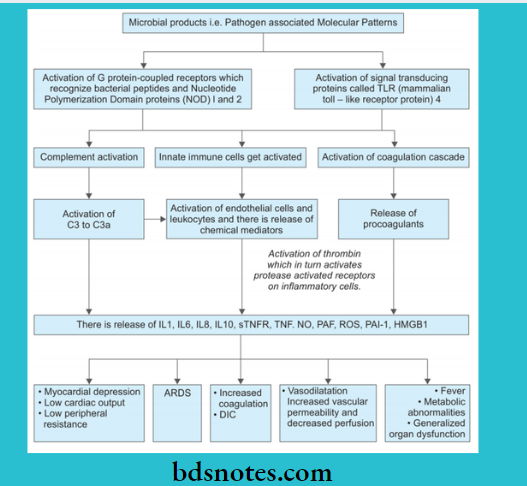
Hemodynamic Changes Septic Shock

Filed Under: Pathology

Reader Interactions

Leave a Reply Cancel reply

Your email address will not be published. Required fields are marked *

Primary Sidebar

Recent Posts

  • Branchial Cleft Cyst: Background, Pathophysiology, Etiology
  • Maxillary Nerve: Origin, Course, And Branches
  • The Father Of Anatomy And A Great Anatomist Herophilus
  • Bone Structure – Anatomy
  • The External Carotid Artery: Anatomy, Branches, And Functions
  • Occipitofrontalis Muscle
  • Superficial Temporal Artery
  • Platysma Muscle
  • Cartilage
  • Cauda Equina And Conus Medullaris Syndromes
  • Subcutaneous Injections And Device Management
  • Types Of Circulation: Pulmonary, Systemic, And Portal
  • Structure Of Skeletal Muscle
  • Elastic Cartilage
  • Cellular Organelles And Structure
  • The Golgi Apparatus – The Cell
  • The Cytoplasmic Inclusions Of Certain Plant Cells
  • Dental Abscess
  • Laser Surgery
  • Our Facial Muscles And Their Functions

Copyright © 2026 · Magazine Pro on Genesis Framework · WordPress · Log in