Tympanic Membrane: Structure, Blood Supply, And Nerve Supply
Question 1. Tympanic membrane
Answer:
- It is thin, translucent partition between the external acoustic meatus and middle ear
- It is placed obliquely at an angle of 55 degrées with the floor of meatus
- It is composed of
- Outer cuticular layer of skin
- Middle fibrous layer
- Inner mucous layer
Tympanic membrane Blood Supply:
- Outer surface deep auricular branch of maxillary artery
- Inner surface anterior tympanic branch of maxillary artery
Tympanic membrane Nerve Supply:
- Outer surface
- Anteroinferior part auriculotemporal nerve
- Posterosuperior part Auricular branch of vagus nerve
- Inner surface
- Tympanic branch of glossopharyngeal nerve
Question 2. Development of tympanic membrane
Answer:
- Tubo-tympanic recess develops from the dorsal part of the first pharyngeal pouch
- Tympanic membrane is formed by apposition of this recess and the first ectodermal cleft
- These two forms the inner and outer epithelial linings
- The intervening mesoderm forms the connective tissue basis.
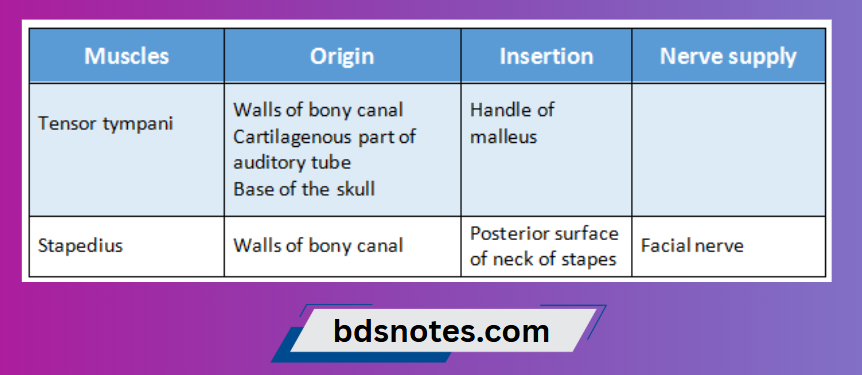
Question 3. Name the muscles of tympanic cavity and their nerve supply.
Answer:
Muscles of tympanic cavity
Question 4. Internal auditory meatus
Answer:
- The internal auditory meatus is a canal within the petrous part of the temporal bone of the skull between the posterior cranial fossa and the inner ear.
- It opens above the anterior part of the jugular foramen
- It is about 1cm long and runs transversely in a lateral direction
It is closed Laterally by a perforated plate of bone known as lamina cribosa which separates it from the internal ear. - It transmits the seventh and eighth cranial nerves and the labyrinthine vessels.
Leave a Reply