Tweed’s Philosophy
Write short note on Tweed diagnostic triangle.
Or
Write short note on Tweed’s triangle.
Or
Write short answer on Tweed’s diagnostic triangle.
Or
Write briefly on Tweed’s analysis.
Or
Write short note on Tweed’s analysis.
Answer.
Tweed’s Analysis
It is a type of cephalometric analysis.
- It is given by Charles Tweed.
- Cephalometric points used are:
- Porion: Superiomost point of orbitale.
- Orbital: Inferiomost point of lower border of orbit.
- Tweed’s analysis makes use of three planes.
- The planes used are:
- Frankfort horizontal plane (FH plane): Join porion and orbitale.
- Mandibular plane: A tangent is drawn to lower border of mandible.
- Long axis of lower incisor: A line is drawn along the long axis of incisors.
Objectives of Analysis
- Determination of the position of lower incisor.
- Evaluation of prognosis.
Angle’s Formed
- Angle’s formed by these three planes are:
- Frankfort mandibular plane angle (FMA)—It is formed by intersection of the FH plane with the mandibular plane.
- The mean value is 25° in well balanced cases.
- Incisors mandibular plane angle (IMPA)—It is the angle formed by the intersection of the long axis of the lower incisor with the mandibular plane.
- It indicates the inclination of the lower incisor.
- The mean value is 90° in well balanced cases.
- Frankfort mandibular incisor angle (FMIA)—It is the angle formed by the intersection of the long axis of the lower incisor with the FH plane.
- The mean value is 65° in well balanced cases.
- Frankfort mandibular plane angle (FMA)—It is formed by intersection of the FH plane with the mandibular plane.
Interpretation
- FMA>28°: This indicates that patient has high angle and growth of mandible is clockwise.
- FMA<23°: This indicates that patient has low angle and growth of mandible is counterclockwise.
- IMPA>110°: Lower incisors are proclined.
- IMPA<85°: Lower incisors are retroclined.
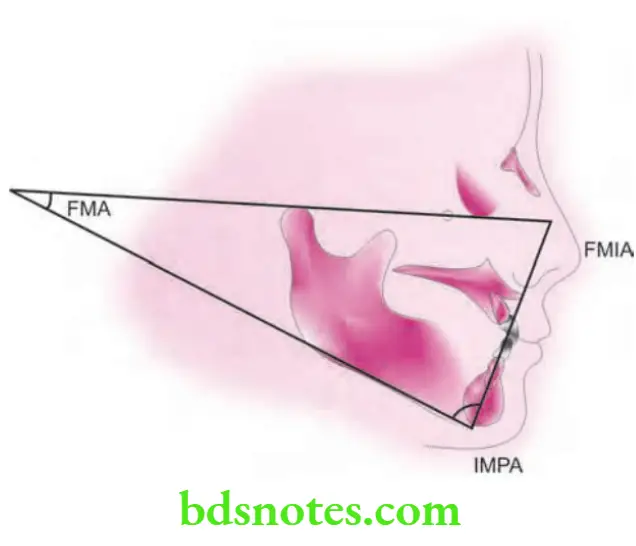
Summary of Tweed’s Triangle
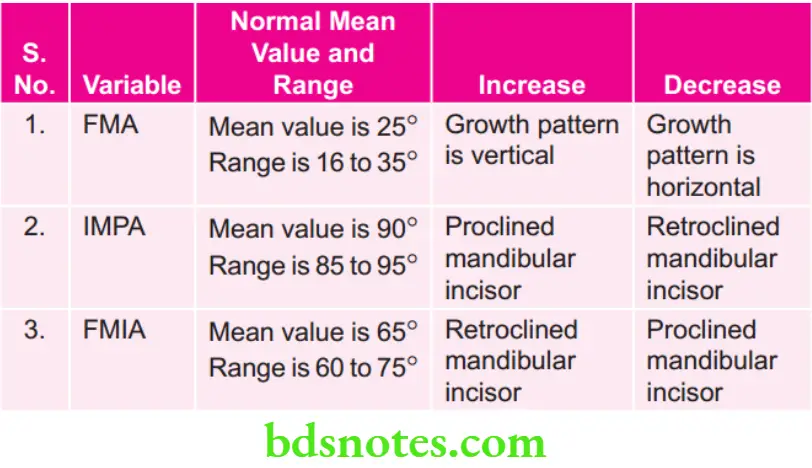
Clinical Importance
- It is used in orthodontics for classification, diagnosis, treatment planning as well as prognosis.
- Tweed had also mentioned about extraction of teeth for correcting the alveolodental prognathism and also the positioning of mandibular incisors upright over the basal bone.
- If FMA is 20° to 30° the prognosis of orthodontic treatment along with extraction is excellent to good.
- If FMA is 30° to 35° the prognosis of orthodontic treatment along with extraction is excellent lies in the range of good to fair.
- If FMA is 35° to 40° the prognosis of orthodontic treatment along with extraction is unfavorable.
Leave a Reply