Treatment Of Class 2 Div 1
Write down the treatment plan of a young growing child with skeletal class 2 div. 1 malocclusion with deep bite. The child exhibits positive VTO on mandibular advancement.
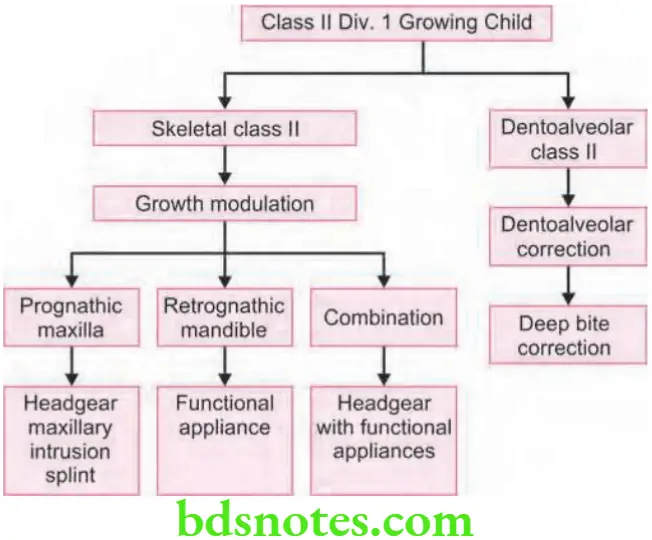
Answer. Flowchart depicts treatment plan for class 2 Div. 1 malocclusion with deep bite in a growing child.
“Understanding the role of Class 2 Div 1 treatment in orthodontics: Q&A explained”
“Importance of studying Class 2 Div 1 treatment for better outcomes: Questions explained”
- Growing child with skeletal class 2 malocclusion should be treated by growth modulation.
- In this case positive VTO on mandibular advancement is suggestive of indication of myofunctional appliances in the treatment.
- Skeletal age and growth potential is assessed with handwrist radiograph.
- Lateral cephalograms helps to locate the skeletal problem.
Prognathic Maxilla
- Inhibition of growth of maxilla for prognathic maxilla, with distalization of maxillary buccal segments is achieved by the extraoral orthopedic force.
- For application of orthopedic force headgears are used.
- Patient wears the appliance for around 12 to 14 hours a day.
- Orthopedic force of 350-450 g/side is applied.
- For vertically growing patients high pull or occipital pull headgear is used.
- For horizontal growing patients cervical pull headgear is used.
- In patients with vertical maxillary excess maxillary intrusion splint is used.
“Common challenges in treating Class 2 Div 1 malocclusion effectively: FAQs provided”
Retrognathic Mandible
- Retrognathic mandible with average FMA angle and lower facial height.
- Activator or FR – 1 is commonly used but bionator, biomodulator, cybernator, propulsor etc. are other functional appliances which are used less commonly.
- Functional appliance acts by placing the mandible in anterior position and also by eliminating the functional retrusion.
- Retrognathic mandible with higher FMA angle and lower facial height
- Activator is used along with high pull headgear.
“Role of counseling in clarifying Class 2 Div 1 goals for patients: Questions answered”
Combination of Prognathic Maxilla and Retrognathic Mandible
- By combination of headgear and functional appliances growth modification is done.
- Activator with headgear is commonly used.
Correction of Dentoalveolar Class 2
- In dentoalveolar class 2, the skeletal base is normal or orthognathic. Defect is in dentoalveolar part.
- Establishment of normal incisor and molar relationship is one of the aims of early correction.
“Asymptomatic vs symptomatic effects of poor communication about Class 2 Div 1: Answered”
- Deep bite correction is done by using anterior bite planes in low angle case while in high angle cases, incisor intrusion is achieved using utility arches.
- Correction of crowding is done by gaining space either by distalization of molars or extraction.
- Retraction of incisors is done by using labial bows or with fixed appliance mechanotherapy.
- Posterior crossbites should be corrected by using crossbite elastics
Leave a Reply