Trauma Service: Primary And Secondary Survey
Write a short note on Surveyor.
Answer.
“Factors influencing success with trauma service knowledge: Q&A”
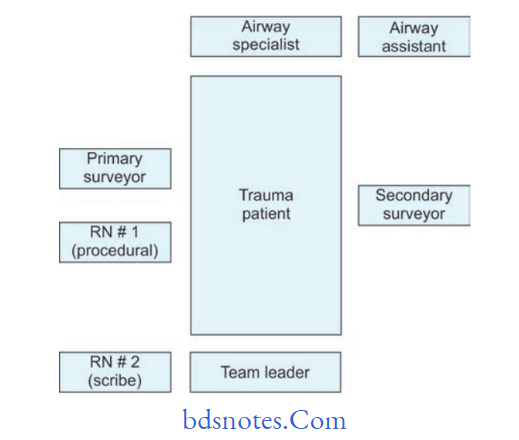
Surveyor is the one of the members of the trauma team.
Surveyors are of two types, i.e. primary surveyor and secondary surveyor.
Primary Surveyor (Surgical resident)
- Performs the primary survey, relaying all pertinent findings to the team.
- May perform the secondary survey, relaying all pertinent findings to the team.
- Performs or assists in the performance of any life-saving procedures at the direction of the team leader
“Understanding primary and secondary surveys in trauma care through FAQs: Key steps explained”
Primary Survey Techniques in Trauma Care
Secondary Surveyor (Surgical resident or intern)
- Assists with the “exposure” aspect of the primary survey and applies warm blankets.
- May perform the secondary survey, relaying all pertinent findings to the team
- Performs or assists in the performance of any life-saving procedures at the direction of the team leader
“Importance of studying trauma service protocols for healthcare professionals: Questions explained”
Secondary Survey Protocols for Trauma Patients
Surveying In Maxillofacial injuries
Primary Survey
- Identify the airway compromise from fracture or hemorrhage.
- Bilateral anterior fractures of the mandible have the risk of falling back of the tongue.
- Orotracheal intubation should be needed.
- With the help of mouth props and epistaxis balloons hemorrhage should be controlled.
- Anterior and posterior nasal packing can be needed.
“Common challenges in conducting primary and secondary surveys effectively: FAQs provided”
Trauma Primary Survey Checklist
Secondary Survey
- Orbital rim, zygomatic arches, and mandible should be palpated to identify fractures.
- Eyes should be examined: Restricted eye movement is suggestive of an orbital fracture.
- Subconjunctival hemorrhage can be suggestive of a fracture of the skull.
- Proptosis and ophthalmoplegia can be suggestive of retrobulbar hemorrhage.
- Sensation should be assessed in the maxillary branch of the trigeminal nerve.
- Check intracanthal distance which should be 30–35mm. If the distance is more than the mentioned range, it is suggestive of nasoethmoid fracture.
- The intraoral examination is necessary. Assess the occlusion and intraoral hematomas.
Leave a Reply