Tooth-Gum Connection: Junctional Epithelium
Write briefly the development of three stages of detinogingival junction.
Answer:
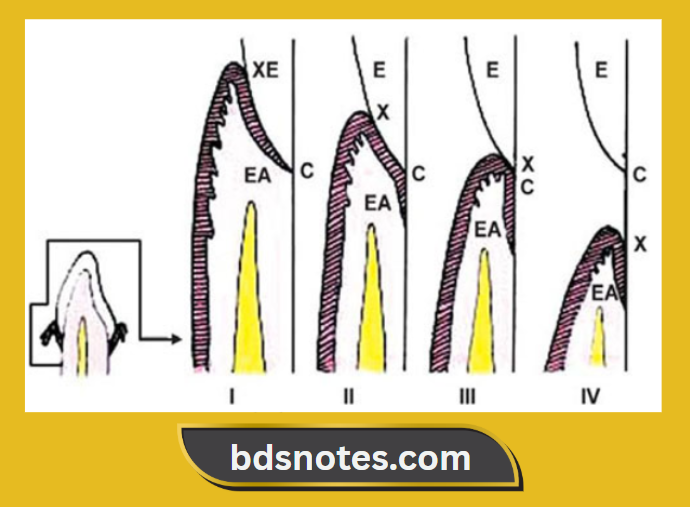
Stages of dentinogingival junction:
1. First stage physiologic:
- Position of the bottom of the gingival sulcus. In the enamel-covered crown.
- Position of the apical end of the attachment epithelium at tire cementoenamel junction.
- The clinical crown is smaller than the anatomic crown.
Age:
- Before 1 year of shedding of primary teeth.
- In permanent teeth, at the age of 20 – 30 years.
2. Second stage – physiologic:
- The bottom of the gingival sulcus is on the enamel.
- The apical end of the attachment epithelium is on the cementum.
- Fiber bundles present at the cervical parts of the cementum undergo dissolution.
- This part later gets covered by the epithelium.
- The apical shift of the gingival and transseptal fibers occurs.
- Fibers are destroyed by the enzymes secreted by the epithelial cells, by plaque or by immunologic reactions.
- The clinical crown is smaller than the anatomic crown.
- Age: 40 years or later.
3. Third stage – pathologic:
- The bottom of the gingival sulcus is at the cementoenamel junction.
- Epithelium attachment is entirely on the cementum.
- The tooth is exposed.
- The epithelium shifts along the tooth surface.
- The clinical crown is equal to the anatomic crown.
4. Fourth stage – pathologic:
- It represents a gingival recession.
- The entire attachment is on the cementum.
- May occur even in the absence of periodontitis.
- The clinical crown is longer than the atomic crown.
Age:
- Varies
- In some cases, occurs at the age of 20’s while absent even at the age of 50 or more.
Leave a Reply