Tissue Regeneration
Write in briefly about tissue regeneration.
Answer:
Regeneration
When healing takes place by the proliferation of parenchymal cells and usually results in the restoration of original tissues.
- In order to maintain the proper structure of tissues, cells are under constant regulatory parenchymal control of their cell cycle.
- Cell cycle is defined as the period between two successive cell divisions and is divided into unequal phases.
- G1 (Pre-Mitotic Gap) Phase: It is the stage when mRNA for proteins and proteins themselves required for DNA synthesis are synthesized.
- S Phase: During this phase synthesis of nuclear DNA takes place.
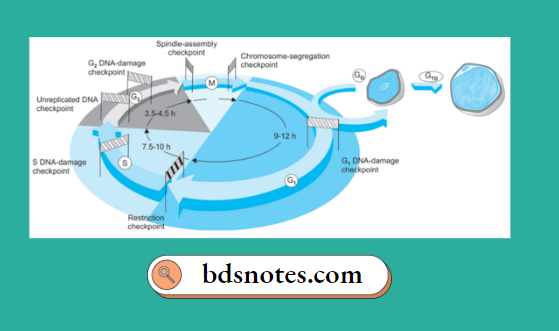
- G2 Phase: It is the short gap phase in which the correctness of DNA synthesized is assessed.
- M Phase: It is the stage in which process of mitosis to form two daughter cells is completed, this occurs in four sequential stages, i.e. prophase, metaphase, anaphase and telophase.
- Prophase:
- Each chromosome divides into two chromatids which are held together by a centromere.
- The centriole divides and two daughter centrioles form the spindle, while the chromosomes line up at the equatorial plate of the spindle.
- Anaphase:
- The centromeres divide and each set of separated chromosomes moves towards the opposite poles of the spindle.
- Cell membrane also begins to divide.
- Telophase:
- There is the formation of a nuclear membrane around each set of chromosomes and the reconstitution of the nucleus.
- The cytoplasm of the two daughter cells completely separates.
- Go Phase: The daughter cells may continue to remain in the cell cycle and divide further or may go out of the cell cycle into the resting phase called as G0 phase.
- Telophase:
- Prophase:
Tissue regeneration
Regeneration of parenchymal cells involves the following two processes:
- The proliferation of original cells from the margin of injury with migration so as to cover the gap.
- The proliferation of migrated cells with subsequent differentiation and maturation so as to reconstitute the original tissue.
Leave a Reply