The Science Of Castable Ceramics: Materials, Fabrication, And Advantages
Write a short note on castable ceramic.
Answer:
Composition Of Castable Ceramic:
The first commercially available castable ceramic material for dental usage is decor which was named on the names of its manufacturers, i.e. Dentsply International and Corning Glass Works, it is supplied as silicon glass plate ingot containing MgF2
Dicor contains 55 vol% of tetra silicic Formica crystals in the glass matrix.
Major Ingredients Of Castable Ceramic:
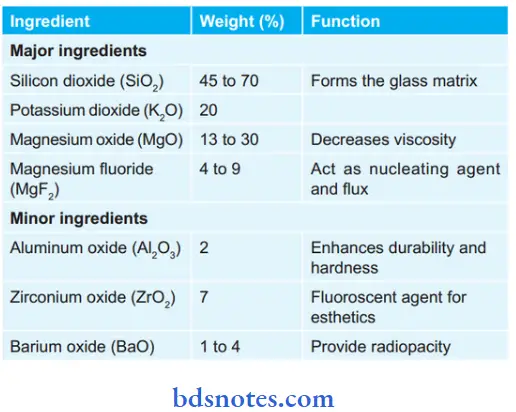
- Sio2 − 45 to 70% forms the glass matrix
- KO2 − 20%
- MgO − 13 to 30% decreases the viscosity
- Mgf2 − 4 to 9% act as nucleating agent and flux
Minor Ingredients Of Castable Ceramic:
- Al2 O3 − 2% enhances durability and hardness
- ZrO2 − 7% fluorescent agent for esthetics
- BaO− 1 to 4% provides radiopacity.
Dicor Of Castable Ceramic:
Castable ceramics are also known as glass ceramics.
- Its properties are closer to that of glass and its construction is quite diffrent.
- This the only porcelain crown made by a centrifugal casting technique.
- The ‘ceramming’ process is also quite unique to this porcelain.
Types of Castable Ceramics:
There are four types of castable ceramics, i.e.
- Dicor
- Apatite glass ceramic—cera pearl
- Lithia based
- Calcium phosphate.
Composition Of Castable Ceramic:
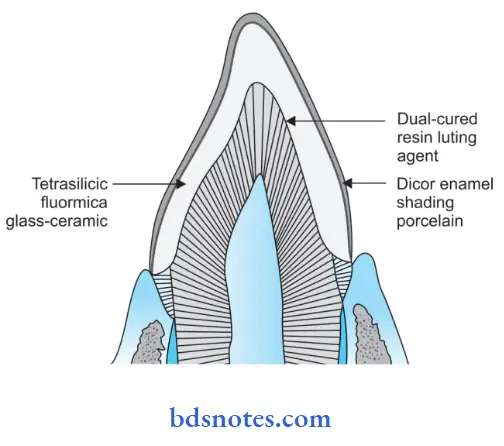
Dicor contains 55 vol% of tetra silicic Formica crystals in a glass matrix
Fabrication of a Dicor Crown:
- The wax crown is first constructed in wax and then invested in investment material like a regular cast metal crown.
- After burning out the wax, nuggets of Dicor glass is melted and cast into the mould in a centrifugal machine.
- The glass casting is carefully recovered from the investment by sandblasting and the spores are gently cut away.
- The glass restoration is then covered with a protective ‘embedment material’ to prepare it for the next stage called cramming.
- Ceramming is a heat treatment process by which the glass is strengthened. It also reduces the transparency of the glass making it more opaque and less glass-like.
- The cramped glass is now built up with enamel and dentin, condensed, and fired to complete the restoration.
Advantages Of Castable Ceramic:
Ease of fabrication
- Esthetics is good
- Marginal fi is good
- Improved strength and fracture toughness
- Processing shrinkage is very low
- Opposing teeth undergo low abrasion.
- Features: The Dicor glass ceramic crown is very aesthetic.
- Uses: Inlays, onlays, veneers, and low-stress crowns.
Disadvantages Of Castable Ceramic:
- Strength is inadequate for posterior use.
- Internal characterization is impossible, so it should be stained externally to improve esthetics.
Lithia based
- They are developed by Uryu.
- Crystals of LiO. Al2O3.4SiO2 is formed after heat treatment.
- It is available as Olympus castable ceramic.
Calcium Phosphate
- It is reported by Kihara.
- It is a combination of calcium phosphate and phosphorus pentoxide plus trace elements.
- It is cast at 1050°C in a gypsum investment mold.
- Clear cast crown is converted to crystalline ceramic by heat treating at 645°C for 12 hours.
Leave a Reply