• Skip to main content
  • Skip to secondary menu
  • Skip to primary sidebar
  • About Us
  • Terms of Use
  • Privacy Policy
  • Disclaimer
  • Contact Us
  • Sitemap

BDS Notes

BDS notes, Question and Answers

  • Public Health Dentistry
  • Periodontics
  • Pharmacology
  • Pathology
  • Orthodontics
    • Anchorage In Orthodontics
    • Mandibular Growth, Functional Matrix
    • Retention and Relapse
  • General Surgery
    • Cysts: Types, Causes, Symptoms
    • Maxillofacial Fractures, Disorders, and Treatments
    • Lymphatic Disorders
    • Neurological and Facial Disorders
  • Temporal And Infratemporal Regions
    • Spinal and Neuroanatomy
  • Dental Materials
    • Dental Amalgam
Home » The Science Behind Breathing: Nervous Control And Reflexes Of Respiration

The Science Behind Breathing: Nervous Control And Reflexes Of Respiration

February 5, 2026 by Kristensmith Taylor Leave a Comment

The Science Behind Breathing: Nervous Control And Reflexes Of Respiration

Describe the nervous regulation of respiration. Add a note on Herring-Breurr’s reflex.
Answer:

Nervous Regulation Of Respiration:

  • It is brought about by

1. Automatic control:

  • Respiration is involuntary controlled by the respiratory centers
  • These respiratory centers are as follows:

2. Voluntary control:

  • Respiration can be modifies both in rate and/or depth at will for a specific period only
  • The pathway for such a control is via corticospinal tract originating from the cerebral cortex and end on spinal motor neurons
  • It innervates the respiratory group of muscles

Herring-Breurr’s reflex Regulation of inspiration:

  • Inspiration is regulated by apneustic center
  • Activation of apneustic center causes stimulation of inspiratory center
  • Inspiratory centre in turn sends impulses via spinal cord to the anterior horn cells
  • This results in inspiration

Herring-Breurr’s reflex Regulation of expiration:

1. Inspiratory neurons from the inspiration center sends excitory impulses to pneumotoxic center

  • Pneutoxic center sends inhibitory impulses to apneustic centre

2. During inspiration, pulmonary stretch receptors are stimulated

  • This send inhibitory impulses to apneustic centre via vagus nerve

3. Pneumataxic center

  • Stimulates expiratory centre
  • Inhibits inspiratory centre
  • Inhibits apneustic centre
  • Thus inspiration is inhibited and expiration occurs passively

Herring Breuer’s Reflex:

  • This reflex occur due to stimulation of stretch receptors present on lungs
  • It prevents overstretching of lung muscles
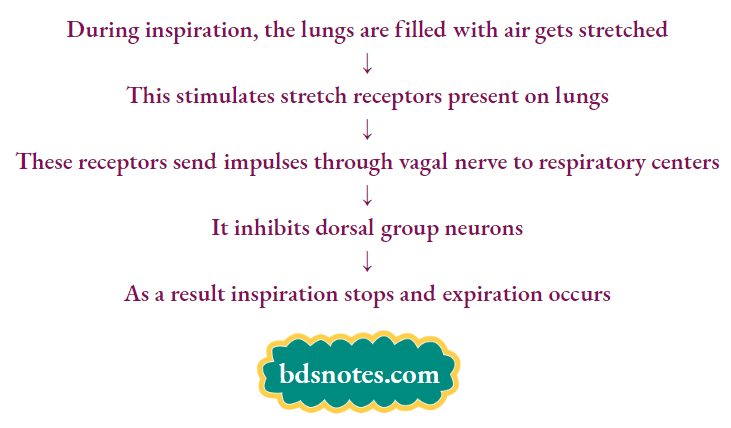
Herring Breuer's Reflex

  • It is also known as Hering Breuer inflation reflex since it occurs due to inflation of lungs
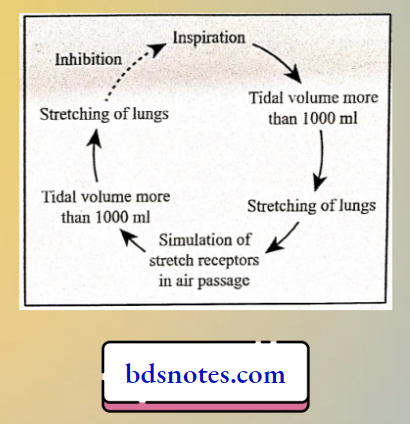
 

Hering Breuer Inglation Reflex

Filed Under: Anatomy

Reader Interactions

Leave a Reply Cancel reply

Your email address will not be published. Required fields are marked *

Primary Sidebar

Recent Posts

  • Branchial Cleft Cyst: Background, Pathophysiology, Etiology
  • Maxillary Nerve: Origin, Course, And Branches
  • The Father Of Anatomy And A Great Anatomist Herophilus
  • Bone Structure – Anatomy
  • The External Carotid Artery: Anatomy, Branches, And Functions
  • Occipitofrontalis Muscle
  • Superficial Temporal Artery
  • Platysma Muscle
  • Cartilage
  • Cauda Equina And Conus Medullaris Syndromes
  • Subcutaneous Injections And Device Management
  • Types Of Circulation: Pulmonary, Systemic, And Portal
  • Structure Of Skeletal Muscle
  • Elastic Cartilage
  • Cellular Organelles And Structure
  • The Golgi Apparatus – The Cell
  • The Cytoplasmic Inclusions Of Certain Plant Cells
  • Dental Abscess
  • Laser Surgery
  • Our Facial Muscles And Their Functions

Copyright © 2026 · Magazine Pro on Genesis Framework · WordPress · Log in