The Parotid Duct: Structure, Course, And Clinical Significance
Question 1. Enumerate the structures present within the parotid gland.
Answer.
From superficial to deep, these are as follows:
- Deep parotid lymph nodes
- Facial nerve
- Retromandibular vein
- External carotid artery
Question 2. Write a short note on the parotid duct (Stensen’s duct).
Answer.
Parotid Duct General Features
- It is a 5-cm long and 3-mm wide tube.
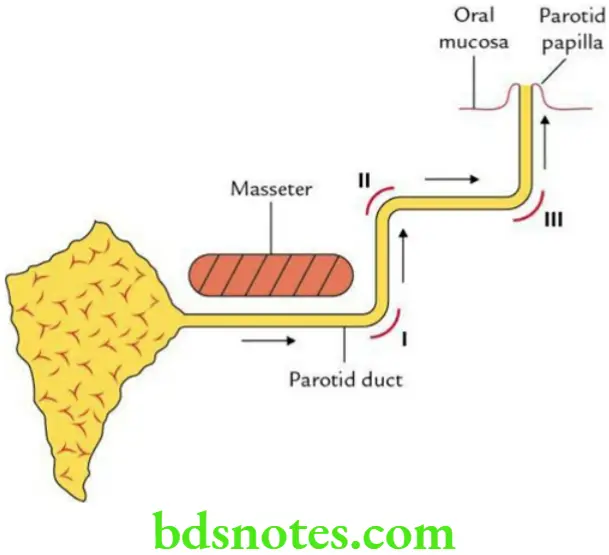
- It emerges from the middle of the anterior border of the parotid gland and opens into the vestibule of the mouth opposite the crown of 2nd upper molar tooth on the parotid papilla.
Parotid Duct Course
- Runs forward over masseter muscle.
- Turns medially (1st bend) at the anterior border of the masseter and pierces buccal pad of fat, buccopharyngeal fascia and buccinator muscle in succession.
- Runs forward (2nd bend) between the buccinator and mucous membrane for some distance.
- Turns medially (3rd bend) to open on the summit of the parotid papilla to pour its secretions in the vestibule of mouth.
Parotid Duct Applied anatomy
- The parotid duct can be palpated and rolled on the firm anterior edge of the masseter.
- The sinuous course of the parotid duct serves as a valve-like mechanism to prevent the entry of infective agents in the duct from the mouth during violent blowing.
Leave a Reply