• Skip to main content
  • Skip to secondary menu
  • Skip to primary sidebar
  • About Us
  • Terms of Use
  • Privacy Policy
  • Disclaimer
  • Contact Us
  • Sitemap

BDS Notes

BDS notes, Question and Answers

  • Public Health Dentistry
  • Periodontics
  • Pharmacology
  • Pathology
  • Orthodontics
    • Anchorage In Orthodontics
    • Mandibular Growth, Functional Matrix
    • Retention and Relapse
  • General Surgery
    • Cysts: Types, Causes, Symptoms
    • Maxillofacial Fractures, Disorders, and Treatments
    • Lymphatic Disorders
    • Neurological and Facial Disorders
  • Temporal And Infratemporal Regions
    • Spinal and Neuroanatomy
  • Dental Materials
    • Dental Amalgam
Home » Tentorium Cerebelli

Tentorium Cerebelli

July 26, 2025 by Kristensmith Taylor Leave a Comment

Tentorium Cerebelli

Question 1. Tentorium cerebella
Answer:

  • It is tent shaped fold of duramater forming the roof of the posterior cranial fossa
  • It separates cerebellum from the occipital lobes of the cerebrum
  • It divides cranial cavity into supratentorial & infratentorial compartments

Margins:

  1. Anterior free margin
  2. Outer attached margin

Surfaces:

  • Superior convex surface
  • Inferior concave surface

“Steps to explain cell types involved in the tentorium cerebelli: Fibroblasts vs endothelial cells: Q&A guide”

Question 2. Diaphragm sellae
Answer:

  • It is a small circular, horizontal fold of duramater forming the roof of the hypophyseal fossa
  • It has a central aperture through which the stalk of the hypophysis cerebri passes

Attachments of tentorium cerebelli

Attachments:

1. Anteriorly

  • To the tuberculum sellae

2. Posteriorly

  • To the dorsum sellae

3. On each side

“Role of fibroblasts in maintaining structural integrity: Questions answered”

  • Continuous with the duramater of the middle cranial fossa
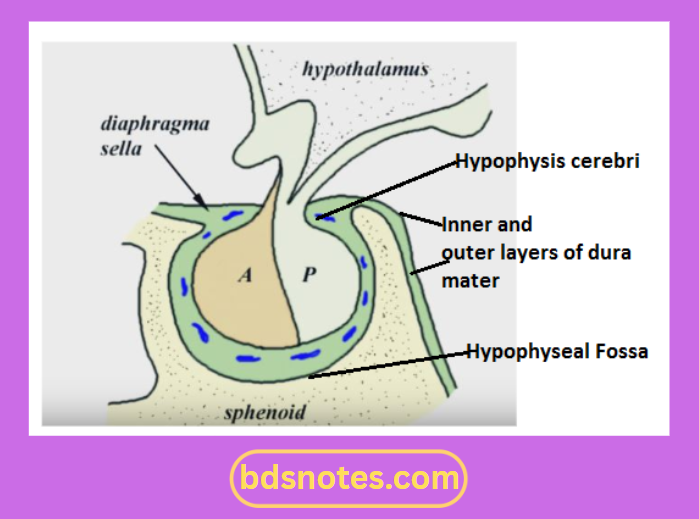
  • Diaphragma Sellae Sagittal Section

“Early warning signs of undiagnosed cell type-related issues: Common questions”

Question 3. Hypoglossal nerve
Answer:

  • It is the twelfth cranial nerve
  • It supplies the muscles of the tongue

Functional components:

  • General somatic efferent
  • General somatic afferent

Nucleus:

  • It lies in the floor of fourth ventricle beneath Hypoglossal triangle

Branches:

1. Branches containing fibres of the Hypoglossal nerve proper

  • They supply extrinsic & intrinsic muscles of the tongue

“Asymptomatic vs symptomatic effects of delayed interventions: Answered”

2. Branches of the hypoglossal nerve containing fibres of nerve C1

  1. Meningeal branch
    • Supplies bone & meninges in the anterior part of the posterior cranial fossa
  2. Descending branch
    • Continues as upper root of the ansa cervicalis
  3. Branches to the thyrohyoid & geniohyoid muscles

Filed Under: Anatomy

Reader Interactions

Leave a Reply Cancel reply

Your email address will not be published. Required fields are marked *

Primary Sidebar

Recent Posts

  • Branchial Cleft Cyst: Background, Pathophysiology, Etiology
  • Maxillary Nerve: Origin, Course, And Branches
  • The Father Of Anatomy And A Great Anatomist Herophilus
  • Bone Structure – Anatomy
  • The External Carotid Artery: Anatomy, Branches, And Functions
  • Occipitofrontalis Muscle
  • Superficial Temporal Artery
  • Platysma Muscle
  • Cartilage
  • Cauda Equina And Conus Medullaris Syndromes
  • Subcutaneous Injections And Device Management
  • Types Of Circulation: Pulmonary, Systemic, And Portal
  • Structure Of Skeletal Muscle
  • Elastic Cartilage
  • Cellular Organelles And Structure
  • The Golgi Apparatus – The Cell
  • The Cytoplasmic Inclusions Of Certain Plant Cells
  • Dental Abscess
  • Laser Surgery
  • Our Facial Muscles And Their Functions

Copyright © 2026 · Magazine Pro on Genesis Framework · WordPress · Log in