Teeth Development In Children
Describe development of dentition in detail.
Or
Describe development of occlusion from birth to 12 years of age.
Answer. Occlusion is defied as “the changing inter-relationship of the opposing surfaces of maxillary and mandibular teeth which occurs during movements of mandible and terminal full contact of the maxillary and mandibular dental arches”.
Periods of Occlusal Development
- Predental/Dentate period.
- Deciduous dentition period.
- Mixed dentition period.
- Permanent dentition period.
“Understanding the role of teeth development in child oral health: Q&A explained”
Predental/Dental Period
- Period from birth to the eruption of the fist deciduous teeth in oral cavity.
- In this period neonate does not have any teeth.
- It usually lasts for 6 months aftr birth.
- The alveolar ridge at this stage is called gum pad.
Gum Pad
The alveolar processes at the time of birth are known as gum pads.
“Importance of studying teeth development for better pediatric outcomes: Questions explained”
- The gum pads are pink, fim and are covered by a dense layer of firous periosteum.
- They are horseshoe, shaped in the maxilla and U-shaped in mandible.
- The gum pads develop in two parts – the labio-buccal portion and the lingual portion.
- The labio-buccal portion develops before the lingual portion.
- The two portion of the gum pads are separated from each other by a groove called dental groove (Dental groove is the site of origin of the dental lamina).
- The gum pads are divided into 10 segments by 10 grooves called transverse groove.
- Each segment contains one developing deciduous tooth sac.
- The transverse groove between the canine and first deciduous molar segment is called lateral sulcus.
- The lateral sulcus of the mandibular arch is normally more distal to that of the maxillary arch. The gum pads meet only at the lateral sulcus on other part the gum pads do not meet, they help in feeding of infant.
“Common challenges in monitoring teeth development in children: FAQs provided”
Gingival Groove
Gingival groove separates the gum pad from palate in maxillary arch and from flor of the mouth in lower arch.
- The gum pads meet only at the lateral sulcus on other part the gum pads do not meet, they help in feeding of infant.
- When the upper and lower gum pads are approximated there is a complete overjet all around. This space is occupied by tongue resulting in tongue thrust.
- The greater the anterior-posterior dimension of the gum pads, the greater the possibility of the child developing malocclusion.
Deciduous Dentition Period
Deciduous dentition period extend from 6 months to 6 years of postnatal life.
Primary teeth begin to erupt at age of 6 months and is completed by 2 ½ to 3 ½ years of age when second deciduous molars come into occlusion.
Eruption sequence of deciduous dentition is A – B – D – C– E.
“Steps to explain different stages of teeth development: Primary vs permanent teeth: Q&A guide”
Various Normal Features of an Ideal Occlusion in Deciduous Dentition
It is good as the space in between the teeth can be utilized for adjustment of permanent successors which are always larger in size from deciduous dentition.
These spaces are of two types:
- Primate.
- Physiological.
Primate Space/Simian Space/Anthropoid Space/Baum Space
- Primate space present between lateral incisor and canine in maxilla (in maxillary arch this space is used up by permanent incisors which are more wider).
- In mandibular arch the primate space present between canine and fist molar (this space is used by permanent molar).
“Role of eruption patterns in primary teeth development: Questions answered”
Physiological/Development Space
- These spaces are present in between the primary teeth and play an important role in normal development of the permanent dentition.
- The total space present may vary from 0 to 8 mm with average 4 mm in maxillary arch and 1 to 7 mm with average 3 mm in mandibular arch.
Shallow overjet and overbite
Ovoid arch form
Almost vertical inclination of anterior teeth
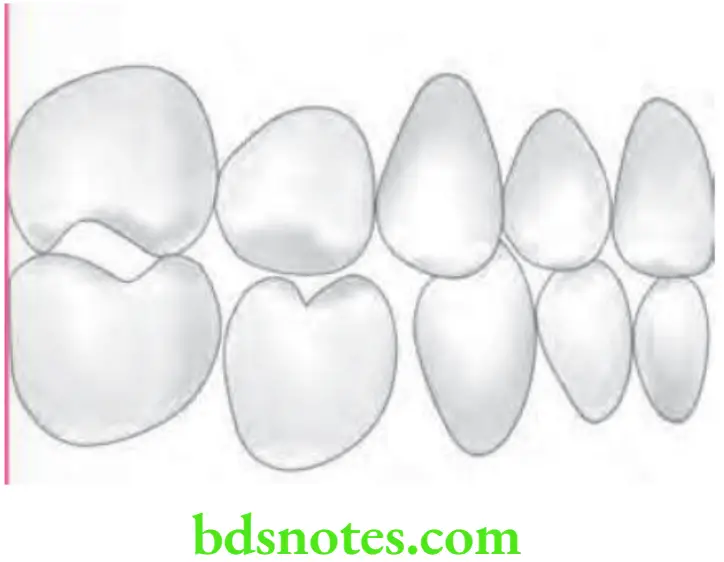
Flush Terminal Plane
The mandibular deciduous second molar is usually wider mesiodistally than the maxillary second deciduous molar giving rise to typical flush terminal plane relationship. When a line is drawn on distal surface of the upper second deciduous molar it falls along the distal surface of lower deciduous second molar. As the fist permanent molars erupt, they will be in end on molar relationship in the presence of complete deciduous dentition having a flush terminal plane. This relation develops into class I molar relationship following exfoliation of lower deciduous second molar, due to the mesial migration of the lower permanent fist molars.
“Early warning signs of delayed teeth development in children: Common questions”
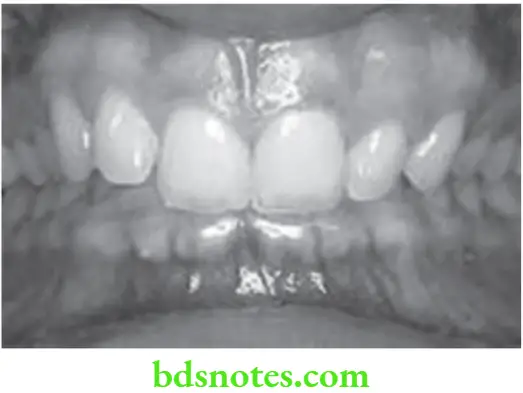
Deep Bite
A deep bite may occur in the initial stages of development. The deciduous incisors are more vertical (than their successors). The lower incisal edge contact the cingulum area of the maxillary incisors, this is called deep bite.
- The deep bite is reduced due to:
- Eruption of permanent posterior teeth
- Attrition of incisors
- Forward and downward movement of mandible due to growth.
“Asymptomatic vs symptomatic effects of ignoring teeth development issues: Q&A”
Mixed Dentition Period
The period during which both the primary and permanent teeth are in mouth. It ranges from 6 to 12 years
- The permanent teeth which erupt in place of deciduous teeth are called successional teeth.
- The teeth those erupt posteriorly to the primary teeth are called accessional teeth.
- The mixed dentition period classified into:
- First transitional period.
- Inter transitional period.
- Second transitional period.
First Transitional Period
Phases/Characteristic features:
- Emergence of fist permanent molar.
- Incisors transition (incisor liability).
- Establishment of occlusion.
“Steps to educate parents about teeth development in children and its importance: Q&A format”
Emergence of First Permanent Molar
- Mandibular fist molar is the fist permanent tooth to erupt at 6 years of age.
- Location as well as relationship of fist permanent molar depends on the distal surface relationship between maxillary and mandibular second primary molars.
- First permanent molars are guided in the dental arch by distal surface of second deciduous molar.
- Mesiodistal relationship between the distal surfaces of maxillary and mandibular second primary molars can be of three types viz:
- Flush terminal plane: Distal surface of upper and lower second primary molar are in the one vertical plane. This is known as flsh or vertical terminal\ plane. It is the normal feature of deciduous dentition. So the erupting fist permanent molars can also be in flsh or end on relationship. For transition of this end on molar relationship to Class I molar relation, lower molar should move forward by 3 to 5 mm relative to upper molar. This happens by utilizing of physiologic spaces and leeway space in lower arch and by the diffrential forward growth of mandible.
- Shif in the mandibular molar from flsh terminal plane to Class I relation occur by two ways i.e. early shift and the late shift
- Early shift: It occurs at the early mixed dentition period. Eruptive force of fist permanent molar is suffient to push deciduous fist and second molars forward in the arch to close primate space and establish a class I molar relationship. As this occurs early, this is known as early shift
- Late shift: As many of the children lack primate spaces and so erupting permanent molars are unable to move forward to establish class I relationship. In such cases, when second deciduous molar exfoliate, permanent molars drif mesially utilizing the leeway space. This occurs in late mixed dentition period and is known as late shift
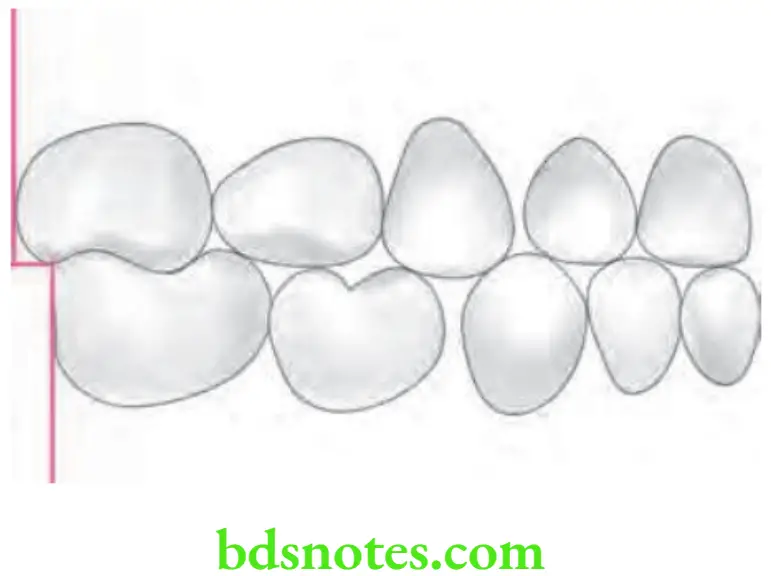
Mesial step terminal plane
In some cases, if the lower deciduous second molar is more mesial than upper deciduous second molar, it gives rise to a mesial step. This lead to a class I molar relationship. This mesial step terminal plane occurs because of early forward growth of mandible. If diffrential growth of mandible in forward direction occurs it leads to class III molar relationship in the permanent dentition.
“Role of counseling in clarifying teeth development goals for parents: Questions answered”
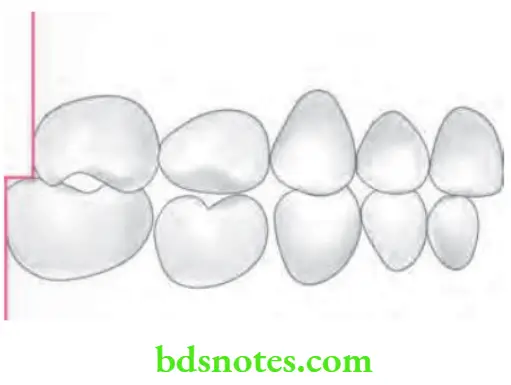
Distal step terminal plane
In some cases where the upper deciduous second molar is ahead of lower deciduous second molar, it gives rise to a distal step. This can lead to class II molar relationship in permanent dentition.
“Early warning signs of knowledge gaps in parent understanding of teeth development: Common questions”
The exchange of incisors
- During the first transition period the deciduous incisors are replaced by permanent incisors.
- The permanent incisors are larger than the deciduous teeth.
- The diffrence between the amount of space needed for the accommodation of the incisors and the amount of space available for this is called “incisor liability”.
- The incisor liability is about 7 mm in the maxillary arch and about 5 mm in the mandibular arch.
- The incisor liability is overcome by:
- Utilization of physiologic space seen in primary dentition.
- Increase in intercanine width.
- Change in incisor inclination.
The primary incisors are more upright than permanent.
The angle between maxillary and mandibular incisors is about 150° in primary dentition whereas it is about 123° in permanent dentition.
Intertransitional period
It lasts about 1.5 years.
- This is a relatively quiet phase and no active tooth eruption is seen.
- This phase containing both set of dentition.
- Four permanent incisors, lef and right permanent fist molars.
- Deciduous canine and molars.
Second transitional period
This period is characterized by the replacement and alignment of the deciduous molars and canines by premolars and permanent cuspids.
The features of second transitional period are:
- Leeway space of Nance.
- Ugly duckling stage.
“Asymptomatic vs symptomatic effects of poor communication about teeth development: Answered”
Leeway space of Nance
- The combined mesiodistal width of permanent canine and premolar is less than deciduous canine and molars.
- This is called Leeway space of Nance.
- It is 1.8 mm in maxillary arch and 3.4 mm in mandibular arch.
- This space is utilized by mandibular molars to establish class I relationship.
Ugly duckling stage
Ugly duckling stage is also known as Broadbent’s phenomenon or physiological midline diastema. Ugly duckling stage occurs from 7 to 11 years of age. As the canine erupts they impinge over the roots of lateral incisors. Erupting pressure of canines leads the lateral incisor to erupt in oral cavity with distal divergence of crown. As the lateral incisor erupts completely the erupting pressure from the canine persist and is transmittd to central incisors which leads to the divergence of crown and convergence of roots towards midline. This effect causes midline diastema, which is self corrected later on. The temporary space which exists between central incisors and at times between central as well as lateral incisors closes spontaneously as canine come into occlusion. This is known as ugly duckling stage.
“Differential applications of traditional vs digital learning methods: Q&A”
Permanent Dentition Period
The entire permanent dentition is formed within the jaws aftr birth except for the cusps of fist molar.
The sequence of eruption for maxillary arch is 6-1-2-4- 5-3-7-8- and in mandibular arch 6-1-2-3-4-5-7-8.
- Some changes that can be seen in permanent dentition are:
- Horizontal overbite decreases.
- Dental arches become shorter.
- Vertical overbite decreases up to the age of 18 years by 0.5 mm.
- Overjet decreases by 0.7 mm between 12 and 20 years of age.
Leave a Reply