Systems Biology Of Facial Development
Describe the development of the face in brief.
Answer.
The face develops from five mesenchymal processes, which appear around the stomodeum (primitive mouth).
- Frontonasal process – unpaired
- Maxillary processes – paired
- Mandibular processes – paired
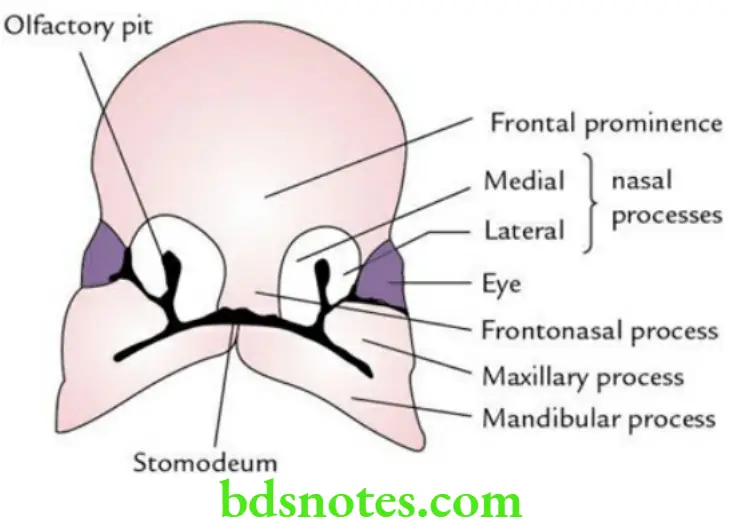
Frontonasal process:
- It lies above the stomodeum and is formed by the proliferation of mesenchyme deep into the ectoderm in front of the forebrain.
- On either side of the frontonasal process, the ectoderm thickens to form olfactory placodes. As each olfactory placode depresses from the surface, the olfactory pit is formed. A horseshoe-shaped elevation is formed around each olfactory pit. The medial limb of horseshoe-shaped elevation is called the medial nasal process, while its lateral limb is called the lateral nasal process.
Maxillary processes: These develop from the mesenchyme of the first arch. They are dorsolateral to lateral nasal processes and are separated from them on each side by the optic vesicle and a lineal furrow of ectoderm termed nasolacrimal groove. Ectodermal cells in the floor of this groove proliferate to form the solid ectodermal cord. The canalization of this cord gives rise to the nasolacrimal duct.
Mandibular processes: These are derived from the mesenchyme of the 1st pharyngeal arch.
The various parts of the face derived from the above-mentioned processes are given in the box below.

Face Applied anatomy
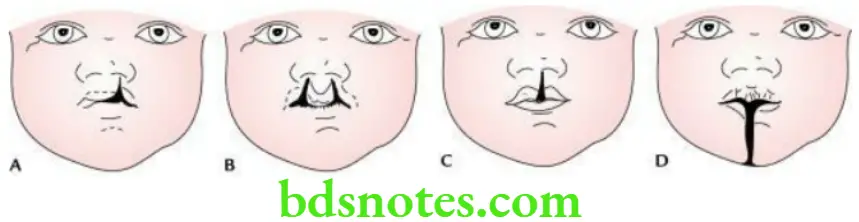
- Cleft upper lip
- Median cleft (or hare lip) occurs if the frontonasal process fails to form philtrum.
- Lateral cleft develops if the frontonasal process fails to fuse with the maxillary process. It can be unilateral or bilateral.
- A cleft lower lip occurs if two mandibular processes fail to fuse with each other. It is very rare.
- Oblique facial cleft occurs if the maxillary process fails to fuse with the lateral nasal process. The oblique cleft extends from the median angle of the eye to the upper lip.
Leave a Reply