Syphilis – Symptoms And Causes
Question 1. Write a short note on tuberculin reaction.
Answer:
This test is done by intradermal injection of 0.1 mL of tuberculin protein, a purified protein derivative.
- Delayed type of hypersensitivity develop in individuals who are having or have been previously infected with tuberculous infection which is identified as an indurated area of more than 15 mm in 72 hours.
- The test may be falsely positive in atypical mycobacterial infection and previous BCG vaccination.
- The test is falsely negative in cutaneous allergy, sarcoidosis, some viral infections, Hodgkin’s disease, recent tuberculosis infection (8 to 10 weeks) and fulminant tuberculosis.
Question 2. Write a short note on syphilis.
Answer:
Syphilis is a venereal (sexually transmitted) disease caused by spirochetes treponema palladium.
T. palladium does not produce any endotoxin and exo- toxin. The pathogenesis of lesions appears to be due to host immune response. Treponema infection is associated with two important antibodies which are:
- The Wasserman antibodies.
- Treponemal antibodies.
Syphilis symptoms
Syphilis Mode of Transmission
- Sexual intercourse: Lesion on glans penis, vulva, vagina and cervix.
- Intimate person-to-person contacts lesion on lips, tongue, or fingers.
- Transfusion of infected blood.
- Maternofetal transmission.
Syphilis Stages of Acquired Syphilis
These are primary, secondary and tertiary depending upon the period after which lesion appear and also on the type of lesions.
Primary Syphilis
A typical lesion of primary syphilis is chancre which appears on the genitals or at extragenital sites in 2-4 weeks after exposure of infection.
- Initially, the lesion is painless papules which an ulcer ate in the center.
- The fully developed chancre is an indurated lesion with central ulceration accompanied by regional lymphadenitis.
- Chancre heal without scaring.
Syphilis causes
Histologically
Chancre shows the following features:
- Dense infiltrate of many plasma cells some lymphocytes and few macrophages.
- There is a perivascular aggregation of mononuclear cells mainly plasma cells
- There is the proliferation of vascular endothelium.
Antibody tests are positive in 1 to 3 weeks after chancre is seen.

Secondary Syphilis
- Inadequately treated patients of primary syphilis develop mucocutaneous lesions and are painless in 2-3 months after exposure.
- Mucocutaneous lesions may be in form of mucus patches of mouth, pharynx and vagina.
- During this stage antibody tests are positive.
- This stage is highly infective and spirochetes are seen in mucocutaneous lesions.

Tertiary Syphilis
About 2-3 years following first exposure, a tertiary lesion of syphilis appears.
- Lesions of tertiary syphilis are much less infective than the other two stages.
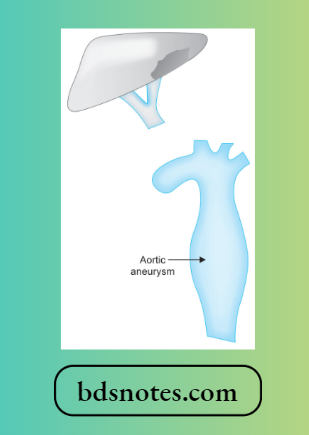
- Lesions of tertiary syphilis are of two types:
1. Syphilitic gumma: It is a localized rubbery lesion with central necrosis seen in the liver, testis, bone and brain.
In liver, it leads to hepar lobatum.
Histologically
Structure of gumma shows:
- Central coagulative necrosis resembles caseation but is less destructive so that outlines of necrosed cells can still be faintly seen.
- Surrounding zone of palisaded macrophages with many plasma cells, some lymphocytes, giant cells and fibroblasts
2. Diffuse lesions of tertiary syphilis: They appear following widespread dissemination of spirochaetes in body. Lesions are seen in the cardiovascular and nervous systems. Lesions are:
- Cardiovascular syphilis: It involves the thoracic aorta. The wall of the aorta get weak and dilated which causes aortic aneurysm, incompetence of the aortic valve and narrowing of coronary ostia.
- Neurosyphilis is manifested as meaning neovascular syphilis in the meninges, tabes dorsalis in the spinal cord and general paresis in the brain.
Diagnostic Tests for Syphilis
The tests are:
1. Nontreponemal antibody tests
- VDRL, i.e. venereal disease research laboratory test
- RPR, i.e. rapid plasma regain test
These tests detect and quantify antibodies to cardiolipin. These tests become positive in 4 to 6 weeks after infection.
These tests are used for screening and for monitoring the response to treatment because they become negative after the therapy.
2. Treponemal antibody tests
- FTA-ABS, i.e. fluorescent treponemal antibody absorption test
- Microhemagglutination assay for T. pallidum antibodies.
These test measure antibodies which specifically react with T. palladium and become positive 4 to 6 weeks after infection, they remain positive even after successful treatment.
Leave a Reply