• Skip to main content
  • Skip to secondary menu
  • Skip to primary sidebar
  • About Us
  • Terms of Use
  • Privacy Policy
  • Disclaimer
  • Contact Us
  • Sitemap

BDS Notes

BDS notes, Question and Answers

  • Public Health Dentistry
  • Periodontics
  • Pharmacology
  • Pathology
  • Orthodontics
    • Anchorage In Orthodontics
    • Mandibular Growth, Functional Matrix
    • Retention and Relapse
  • General Surgery
    • Cysts: Types, Causes, Symptoms
    • Maxillofacial Fractures, Disorders, and Treatments
    • Lymphatic Disorders
    • Neurological and Facial Disorders
  • Temporal And Infratemporal Regions
    • Spinal and Neuroanatomy
  • Dental Materials
    • Dental Amalgam
Home » Surgical Wounds

Surgical Wounds

July 24, 2025 by Kristensmith Taylor Leave a Comment

Surgical Wounds

Enumerate the various types of surgical wounds and describe their management.
Answer.
Surgical wounds are classified into four categories according to possibility of infection occurring in them.
“Understanding surgical wounds through FAQs: Causes, symptoms, and treatments explained”
Management Of Surgical Wounds
  • Airways should be maintained.
  • Bleeding of the patient should be controlled.
  • IV flids should be started.
  • If it is an incised wound, then primary suturing is done after thorough cleaning.
  • If it is a lacerated wound, then it is excised and primary suturing is done.
  • If it is a crushed wound, there will be edema and tension in wound. In such cases, debridement of wound is done and all the devitalized tissues are excised, edema should subside in 5 to 6 days.

“Common challenges in managing surgical wounds effectively: FAQs provided”

  • Afterwards, delayed primary suturing is done.
  • If the wound is deep devitalized, debridement of wound is done and it is allowed to granulate completely.
    • If wound is small secondary suturing is done.
    • If wound is large, split skin graft is used to cover the defect.
  • If wound is with tension, then fasciotomy is done.
  • Antibiotics, flid and electrolytic balance, blood transfusion, tetanus toxoid or anti-tetanus globulin injection.
“Importance of studying surgical wounds for healthcare professionals: Questions explained”
Classification of Surgical Wounds
See The Table below
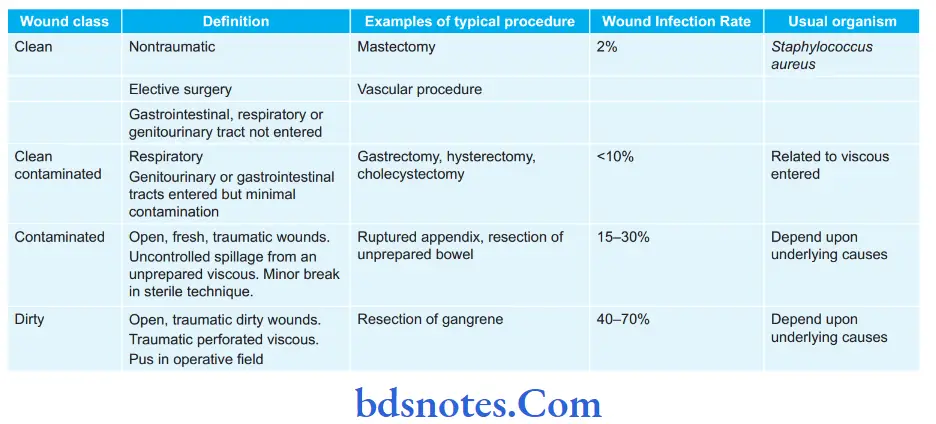
Wound, Sinus and Fistula Classification of Surgical Wounds

Filed Under: General Surgery

Reader Interactions

Leave a Reply Cancel reply

Your email address will not be published. Required fields are marked *

Primary Sidebar

Recent Posts

  • Branchial Cleft Cyst: Background, Pathophysiology, Etiology
  • Maxillary Nerve: Origin, Course, And Branches
  • The Father Of Anatomy And A Great Anatomist Herophilus
  • Bone Structure – Anatomy
  • The External Carotid Artery: Anatomy, Branches, And Functions
  • Occipitofrontalis Muscle
  • Superficial Temporal Artery
  • Platysma Muscle
  • Cartilage
  • Cauda Equina And Conus Medullaris Syndromes
  • Subcutaneous Injections And Device Management
  • Types Of Circulation: Pulmonary, Systemic, And Portal
  • Structure Of Skeletal Muscle
  • Elastic Cartilage
  • Cellular Organelles And Structure
  • The Golgi Apparatus – The Cell
  • The Cytoplasmic Inclusions Of Certain Plant Cells
  • Dental Abscess
  • Laser Surgery
  • Our Facial Muscles And Their Functions

Copyright © 2026 · Magazine Pro on Genesis Framework · WordPress · Log in