Supportive Periodontal Therapy
Question 1. Write short note on supportive periodontal therapy.
Or
Write short note on SPT (supportive periodontal therapy).
Or
Write short answer on supportive periodontal therapy and its importance.
Answer. It is also called as maintenance phase or recall phase.
Periodontal Therapy Importance
- It is an integral part of periodontal therapy. It is the extension of periodontal therapy.
- It is usually started after the completion of periodontal therapy and continues at varying intervals for life of dentition or implant replacement.
- It follows paradigms of etiology and pathogenesis of periodontal disease.
Read And Learn More: Periodontics Question And Answers
Periodontal Therapy Rationale
To prevent or minimize the recurrence of periodontal disease by controlling known factors which contribute the periodontal disease process.
Aims of SPT
- Main aim is to provide supervised control for the patient in order to maintain a healthy and functional natural dentition for life
Periodontal Therapy Objectives
- Preservation of alveolar bone support.
- Maintenance of stable, clinical attachment level.
- Reinforcement and re-evaluation of proper home care.
- Maintenance of healthy and functional oral environment.
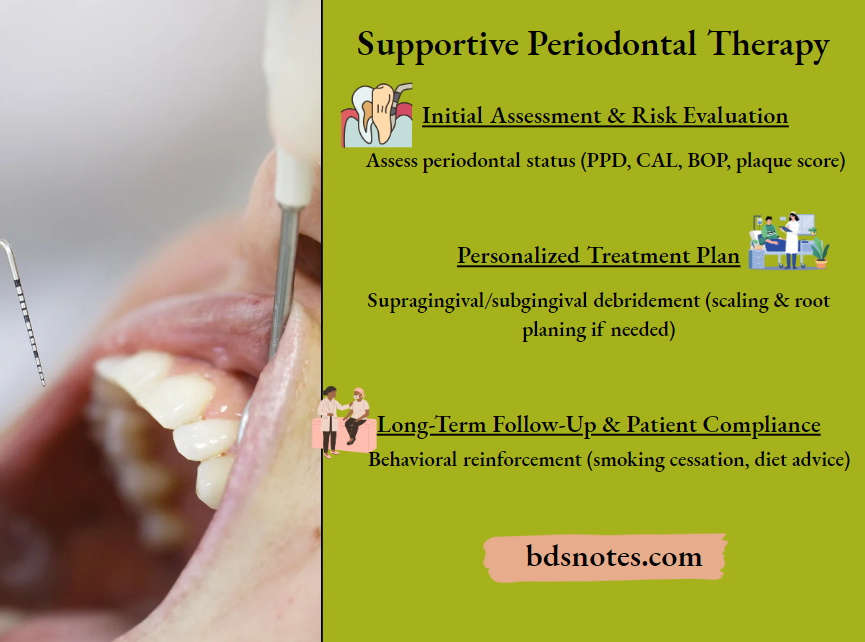
Parts of Supportive Periodontal Treatment
Part 1: Examination (Approximate time—14 min)
- Medical history changes
- Oral pathological examination
- Oral hygiene status
- Gingival changes
- Pocket depth changes
- Mobility changes
- Occlusal changes
- Restorative and prosthetic changes.
Part 2: Treatment (Approximate Time—35 min)
- Oral hygiene reinforcement
- Scaling and polishing
- Chemical irrigation site specific anti-microbial placements.
Part 3: Report, clean up and schedule next procedure (approximate time: 10 min)
- Write report in the chart
- Discuss report with the patient
- Clean and disinfect the operatory
- Schedule next recall visit
- Schedule further periodontal treatment
- Schedule or refer to restorative or prosthetic treatment.
Periodontal Therapy Examination and Evaluation
- Recall examination is similar to the initial evaluation of the patient. Dentist should look for the changes which occur since the last evaluation.
- Current oral hygiene status of the patient should be analyzed.
- Updating the changes in medical history and evaluation of restoration, caries, prosthesis, occlusion, tooth mobility, gingival status and periodontal and peri-implant probing depths are important parts of recall appointment.
- Inspect the oral mucosa carefully for checking the pathological conditions.
- Radiographic examination should be individualized, depending on initial severity of case and findings at the recall visit. They are also compared with the findings of previous radiographs to check bone height and look for repair of osseous defects, sign of trauma from occlusion, periapical pathological changes and dental caries.
Periodontal Therapy Treatment
- Required scaling and root planing should be performed which is followed by oral prophylaxis.
- Care should be taken not to instrument the normal sites with the shallow sulci because repeated subgingival scaling and root planning in initial normal periodontal sites results in significant loss of attachment.
- Irrigation with anti-microbial agents or placement of site specific antimicrobial devices is performed in maintenance patients with the remaining pockets.
Periodontal Therapy Determination of Maintenance Recall Visit
Following factors should be considered in determining the recall intervals:
- Severity of disease: More severe the disease, more frequently should be the patient recalled.
- Effectiveness of homecare: Good home care decreases the frequency of recall.
- Degree of control of inflammation achieved: As tissue regains the total health, frequency decreases.
Periodontal Therapy Sequence of Maintenance Visits
Schallhorn and Snider (1981) proposed four separate categories of periodontal maintenance therapy. They are:
- Preventive maintenance therapy: Periodontally-healthy individuals.
- Trial maintenance therapy: Mild to moderate periodontitis.
- Compromised maintenance therapy: Medically compromised patients where active therapy is not possible.
- Post maintenance treatment therapy: Maintenance for prevention of recurrence of disease.
Leave a Reply