Superior Cervical Ganglion
Question 1. Superior cervical ganglion situation and branches
Answer:
- Superior cervical ganglion is largest of three ganglia
- It is spindle shaped structure
- It is 2.5 cm long
Situation:
- Below the skull
- Opposite to C2 and C3 vertebrae
- Behind carotid sheath
- Front of prevertebral fascia
“Understanding the superior cervical ganglion through FAQs: Composition, functions, and uses explained”
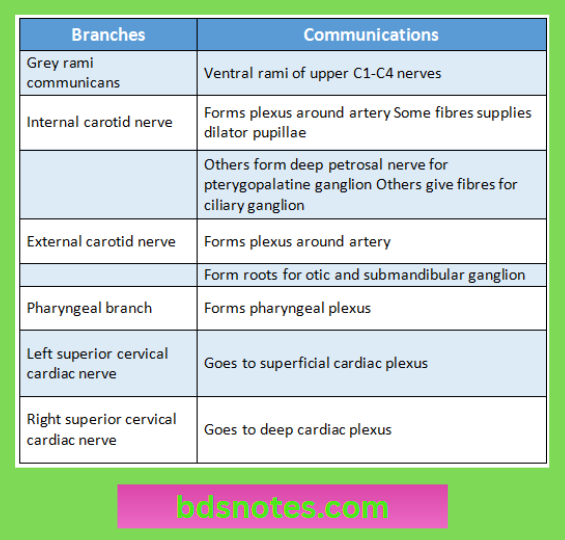
Branches:
“Importance of studying the superior cervical ganglion for medical students: Questions explained”
Question 2. Esophagus
Answer:
- It is a muscular food passage lying between the trachea & the vertebral column
- It is downward continuation of the pharynx
- It begins at the lower border of the cricoid cartilage, opposite the lower border of the body of vertebra C6
- It ends into cardiac end of the stomach in the abdomen
- It is about 25 cm long
“Common challenges in mastering superior cervical ganglion notes effectively: FAQs provided”
Question 3. Thyroid gland
Answer:
Position:
- It lies against vertebrae C5, C6, C7 & T1, in front & at sides of trachea
Parts:
- Each gland consists of two lobes connected by an isthmus
Superior cervical ganglion function
Question 4. Accessory nerve
Answer:
- It is 11th cranial nerve
- It has two rootscranial & spinal
Functional Components:
1. Cranial root is special visceral efferent
- It arises from the lower part of nucleus ambiguus
“Factors influencing success with superior cervical ganglion studies: Q&A”
2. Spinal root is also special visceral efferent
- It arises from a long spinal nucleus
Distribution:
1. Cranial root
- Distributed to the muscles of the palate, pharynx, larynx
2. Spinal root
- Distributed to the sternocleidomastoid & trapezius muscle
Leave a Reply