• Skip to main content
  • Skip to secondary menu
  • Skip to primary sidebar
  • About Us
  • Terms of Use
  • Privacy Policy
  • Disclaimer
  • Contact Us
  • Sitemap

BDS Notes

BDS notes, Question and Answers

  • Public Health Dentistry
  • Periodontics
  • Pharmacology
  • Pathology
  • Orthodontics
    • Anchorage In Orthodontics
    • Mandibular Growth, Functional Matrix
    • Retention and Relapse
  • General Surgery
    • Cysts: Types, Causes, Symptoms
    • Maxillofacial Fractures, Disorders, and Treatments
    • Lymphatic Disorders
    • Neurological and Facial Disorders
  • Temporal And Infratemporal Regions
    • Spinal and Neuroanatomy
  • Dental Materials
    • Dental Amalgam
Home » Stages Of Spermatogenesis: From Spermatogonia To Mature Sperm

Stages Of Spermatogenesis: From Spermatogonia To Mature Sperm

February 5, 2026 by Kristensmith Taylor Leave a Comment

Stages Of Spermatogenesis: From Spermatogonia To Mature Sperm

Question 1. What is the effect of female sex hormones in the growth of mammary gland?

Answer:

Role of female sex hormones on mammary glands:
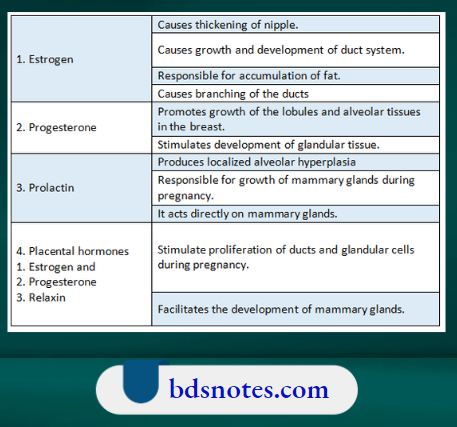
Effect Of Female Sex Hormones Int He Growth Of Mammary Gland

Question 2. Describe the stages of spermatogenesis.
Answer:

  • Spermatogenesis is the process of formation of male gametes called spermatozoa from primitive germ cell in the testis

Stages:

1. Stage of proliferation

  • Each spermatogonia contains 22 autosomes and one sex chromosome either X or Y
  • During this stage, spermatogonia divides by mitosis
  • Chromosome number remain unchanged
  • Spermatogonia migrates towards the lumen of seminiferous tubules

2. Stage of growth

  • Primary spermatocyte formed grows into large cells

3. Stage of maturation

  • Each primary spermatocyte is divided by meiosis in 2 stages
  • As a result, total 4 spermatids are formed with half number of chromosome

4. Stage of transformation

  • The spermatids formed are transform into mature spermatozoa called sperms
  • These sperms are then release into the lumen of seminiferous tubules

Question 3. Functions of testis
Answer:

1. Helps in production of gamete in the gonads

  • Testis helps in gametogenesis
  • It is process by which male gametes called sperms are formed from the primitive spermatogenic cells in the testis
  • It takes 74 days

2. It synthesis and secretes androgenic hormones

  • They are
    • Testosterone in large quantity – functions
  • Sex differentiation in fetus by
    • Suppressing growth of mullerian ducts
    • Causing growth of wolffian ducts
  • Development of external genitalia and accessory sex organs namely genital ducts, seminal vesicle and prostrate
  • Descent of testis from abdominal cavity to scrotum
  • It has effect on sex organs and secondary sexual characters in adults
    • Dihydrotestosterone
    • Androstenediones
  • These are secreted by the interstitial cells of leydig in testis

3. Production and storage of viable sperms

Filed Under: Anatomy

Reader Interactions

Leave a Reply Cancel reply

Your email address will not be published. Required fields are marked *

Primary Sidebar

Recent Posts

  • Branchial Cleft Cyst: Background, Pathophysiology, Etiology
  • Maxillary Nerve: Origin, Course, And Branches
  • The Father Of Anatomy And A Great Anatomist Herophilus
  • Bone Structure – Anatomy
  • The External Carotid Artery: Anatomy, Branches, And Functions
  • Occipitofrontalis Muscle
  • Superficial Temporal Artery
  • Platysma Muscle
  • Cartilage
  • Cauda Equina And Conus Medullaris Syndromes
  • Subcutaneous Injections And Device Management
  • Types Of Circulation: Pulmonary, Systemic, And Portal
  • Structure Of Skeletal Muscle
  • Elastic Cartilage
  • Cellular Organelles And Structure
  • The Golgi Apparatus – The Cell
  • The Cytoplasmic Inclusions Of Certain Plant Cells
  • Dental Abscess
  • Laser Surgery
  • Our Facial Muscles And Their Functions

Copyright © 2026 · Magazine Pro on Genesis Framework · WordPress · Log in