Spinal Cord
Question 1: What is the spinal cord? List its functions.
Answer.
Spinal cord
The spinal cord is a long lower cylindrical part of the central nervous system. It is about 45 cm long and lies in the upper two-thirds of the vertebral canal. It extends from the lower border of the medulla oblongata to the lower border of the L1 vertebra. It encloses the central canal of the spinal cord which contains CSF. It gives off 31 pairs of spinal nerves.
Functions Of Spinal Cord
- Transmission of sensory information from most of the body to the brain
- Transmission of motor information from the brain to the body
- Execution of simple reflexes
“Understanding the anatomy and function of the spinal cord through FAQs: Q&A explained”
Question 2: Write a short note on the ventral spinothalamic tract.
Answer. The ventral spinothalamic tract carries light/simple touch (crude touch), pressure, and itching sensations from the opposite half of the body.
The course of this tract is the same as that of the lateral spinothalamic tract, except that the second-order neurons after crossing to the opposite side ascend in the contralateral ventral white column of the spinal cord.
Ventral Spinothalamic Tract Applied Anatomy The damage of the ventral spinothalamic tract leads to loss of light touch (crude touch) and pressure on the opposite side of the body below the level of the lesion.
“Importance of studying the spinal cord for medical and neuroscience students: Questions explained”
Exploring The Blood Supply Of The Spinal Cord: Key Arteries And Their Functions
Enumerate the arteries supplying the spinal cord.
Answer. The spinal cord is supplied by the following arteries.
Anterior Spinal Artery
It is the artery formed by the union of anterior spinal branches of the vertebral arteries. It descends on the front of the spinal cord in the anterior median fissure.
Posterior Spinal Arteries
These are two posterior spinal arteries, one on each side. They are the branches of vertebral arteries. Each posterior spinal artery divides into two branches, which descend one on either side of the dorsal nerve roots of the corresponding side in the posterolateral sulcus.
“Common challenges in understanding spinal cord anatomy effectively: FAQs provided”
Radicular Arteries (segmental arteries)
They run along the spinal nerve roots to reach the spinal cord. Their sources of origin vary in the different regions. From above downwards, they are branches of the deep cervical and ascending cervical in the cervical region, posterior intercostals in the thoracic region, and subcostal and upper lumbar arteries.
The segmental/radicular arteries at the T1 and T11 spinal segment levels are large and are termed arteria radicularis magna.
“Steps to explain the anatomy of the spinal cord: Gray matter vs white matter vs tracts: Q&A guide”
Ascending And Descending Tracts Of The Spinal Cord
Enumerate the main ascending and descending tracts present within the spinal cord.
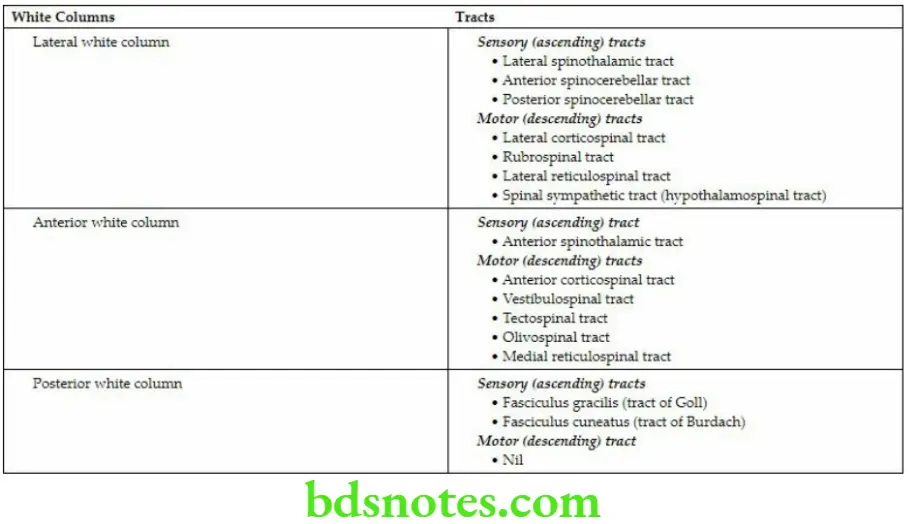
Answer. In each half of the spinal cord, the white matter is divided into three regions called white columns.
The important ascending and descending tracts in each white column of the spinal cord.
Ascending and Descending Tracts in White Columns
The main ascending and descending tracts as seen in the transverse section of the spinal cord.
“Factors influencing success with spinal cord knowledge: Q&A”
Leave a Reply