Specialized Mucosa Of The Tongue: Structure And Features
Question 1. Specialized mucosa
Answer:
- The mucous membrane covering the dorsum of the tongue is called specialized mucosa
Dorsum of the tongue:
- It is rough and irregular
- It is divided by the V-shaped groove called sulcus terminals into
- Anterior two-third or papillary part
- Posterior one third or lymphatic part
Papillae of the tongue:
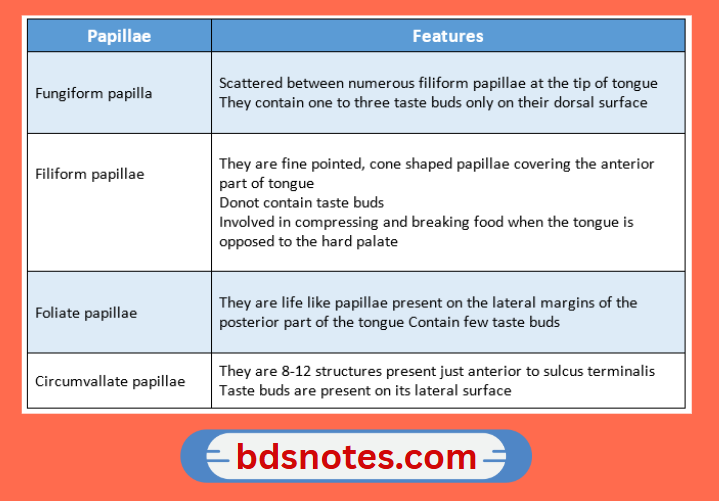
Posterior one-third of the tongue:
- It contains round or oval prominences called lingual follicles
- Each of these has one or more lymph nodules
- The lingual follicles together form lingual tonsil
Question 2. Lining mucosa
Answer:
- The oral mucosa covering the underside of the tongue, inside of the lips, cheeks, floor of the mouth, vestibule, and alveolar mucosa are classified as lining mucosa.
Histology:
1. Epithelium
- Non-keratinized stratified squamous epithelium
- The surface is flexible to withstand stretching
2. Junction between epithelium and lamina propria
- Smooth
- Connective tissue papilla often penetrates into the epithelium
3. Lamina propria
- Thicker
- Contains fewer irregular collagen fibers and elastic fibers
4. Submucosa
- The mucosa of the soft palate is separated from the loose and highly glandular submucosa by a layer of elastic fibers
Functions:
- Collagen fibers help to stretch the mucosa to a certain limit
- Elastic fibers tend to control the extensibility of the mucosa
Leave a Reply