Scalene Muscles: Innervation, Function, Action, Location
Describe the origin, insertion, nerve supply, actions and relations of Scalenus Anterior Muscle.
Answer.
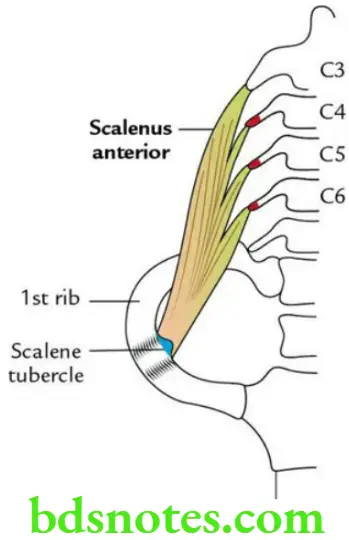
Scalenus Anterior Muscle Origin
From anterior tubercles of transverse processes of C3 to C6 vertebrae.
“Understanding the anatomy and function of the scalene muscles through FAQs: Q&A explained”
“Importance of studying the scalene muscles for medical and anatomy students: Questions explained”
Scalenus Anterior Muscle Insertion
Into scalene tubercle on the inner border of 1st rib.
Scalenus Anterior Muscle Nerve supply
By ventral rami of C4 to C6 spinal nerves.
Scalenus Anterior Muscle Actions
- Acting from below, it bends the neck forwards and laterally.
- Acting from above, it elevates the 1st rib and thus acts as an accessory muscle of respiration.
“Common challenges in understanding scalene muscles effectively: FAQs provided”
Scalenus Anterior Muscle Relations
It is key muscle at the root of neck because many important structures are related to it.
Scalenus Anterior Muscle Anterior relations:
- Two nerves: Phrenic nerve and descendens cervicalis
- Two arteries: Transverse cervical and suprascapular
- Two veins: Anterior jugular and subclavian
- Two muscles: Inferior belly of omohyoid and sternocleidomastoid
“Role of the anterior scalene muscle in elevating the first rib: Questions answered”
Scalenus Anterior Muscle Posterior relations:
- Branchial plexus (lower trunk)
- Subclavian artery (second part)
- Cervical pleura
- Suprapleural membrane
“Factors influencing success with scalene muscle knowledge: Q&A”
Scalenus Anterior Muscle Lateral:
Trunks of brachial plexus
Scalenus Anterior Muscle Medial:
Thyrocervical trunk
“Steps to explain the anatomy of the scalene muscles: Attachments vs innervation vs action: Q&A guide”
Scalenus Anterior Muscle Applied anatomy
- Scalene syndrome occurs if roots of brachial plexus and subclavian artery are compressed between scalenus anterior muscle and first rib.
- Cervical rib syndrome occurs when cervical rib passing through a gap between scalenus anterior and scalenus medius muscles compressing lower trunk of brachial plexus and subclavian artery.
- Clinically these syndromes present as:
- Tingling and numbness in the little finger and medial half of ring fingers due to involvement of T8 and T1.
- Absence of radial pulse due to compression of subclavian artery.
Leave a Reply