Sandwich Technique
Question 1. Classify dental resins.
Answer:
Classification of Dental Resin:
- Unfiled resin (no filers), i.e. acrylic resin
- Filled resin, i.e. composites
- Preventive resin, i.e. pit and fissure sealants
Question 2. Write in brief on the sandwich technique.
Answer:
In the sandwich technique glass ionomer cement is sandwiched between the tooth and composite resin restorative material. Here glass ionomer cement acts as a bonding agent.
As composite resins do not adequately bond to dentin, during polymerization a gap may result if the cavity margin is situated in dentin. This bond to dentin is improved by placing a glass ionomer liner between composite restoration and dentin.
Glass ionomer bonds to dentin via chemical adhesion, while the resin bonds mechanically to porosities and crazing present on the surface of the glass ionomer liner. For improving the retention glass ionomer can be acid-etched.
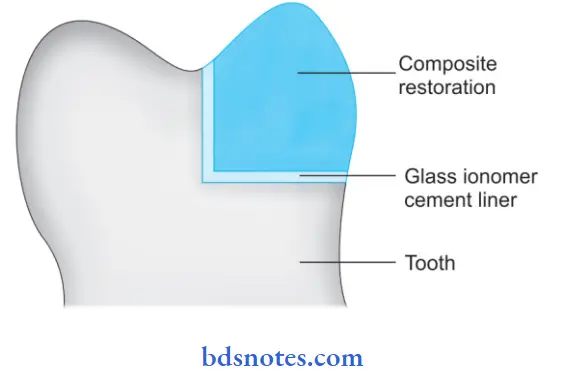
The procedure of the Sandwich technique:
- Condition the dentin and place the thin layer of GIC cement.
- The enamel portion should be etched with phosphoric acid. Some operators also etch the surface of GIC with phosphoric
acid to enhance surface roughness. - Wash the surface for 25 to 30 seconds.
- After adequate drying apply the bonding agent to the surface of the enamel and etched cement surface.
- Insert the composite resin in the usual manner.
Indications of Sandwich technique:
- In Class II composite restorations.
- Lesions where one or more margins are in dentin, i.e. cervical lesions
Leave a Reply