Roots Of The Ciliary Ganglion
Ciliary Ganglion Location: It is a small peripheral parasympathetic ganglion of pin-head size (about 2 mm in diameter), located near the apex of orbit, between the optic nerve and lateral rectus muscle.
Ciliary Ganglion Roots
The roots are 3 in number as follows:
“Understanding the anatomy and function of the roots of the ciliary ganglion through FAQs: Q&A explained”
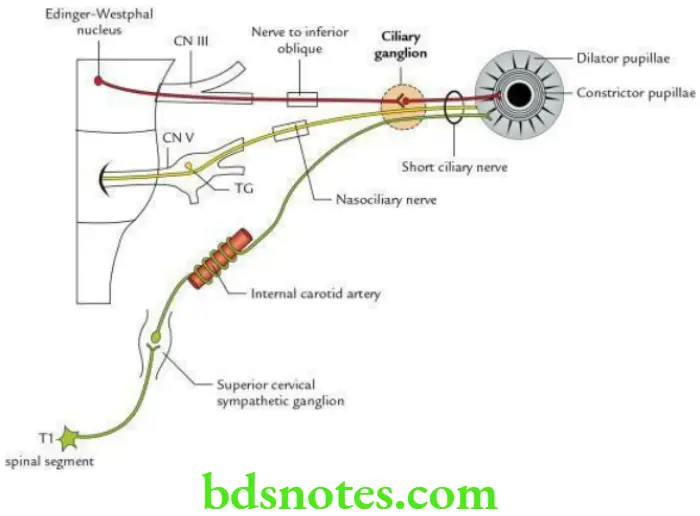
- Parasympathetic root: It is derived from the inferior division of the oculomotor nerve. The preganglionic fibres arise from Edinger–Westphal nucleus, run in the inferior division of the oculomotor nerve and pass through the nerve to the inferior oblique to relay in the ciliary ganglion. The postganglionic parasympathetic fibres arise from ganglion and run through short ciliary nerves.
- Sympathetic root: It is derived from the sympathetic plexus around the internal carotid artery. The preganglionic sympathetic fibres arise from the T1 spinal segment and relay in the superior cervical sympathetic ganglion. The postganglionic fibres arise from this ganglion, form a plexus around the internal carotid artery and pass through the ciliary ganglion without a relay to enter into short ciliary nerves.
- Sensory root: It is derived from the nasociliary nerve – a branch of the ophthalmic nerve that passes through the ganglion without relay.
“Importance of studying the roots of the ciliary ganglion for medical students: Questions explained”
“Common challenges in understanding the roots of the ciliary ganglion effectively: FAQs provided”
Ciliary Ganglion Distribution
The distribution of its branches is as follows:
- Parasympathetic fibres: They supply sphincter pupillae and ciliary muscles through short ciliary nerves.
- Sympathetic fibres: They supply dilator pupillae and blood vessels of the eyeball through short ciliary nerves.
- Sensory fibres: They provide sensory innervation to the whole eyeball, except the conjunctiva, through short ciliary nerves. The sensory supply of conjunctiva is derived from frontal, lacrimal and infraorbital nerves.
Leave a Reply