Role Of Renin In Blood Pressure Regulation: Mechanism And Physiology
Question 1. Cystmetrogram
Answer:
- Cystometrogram allows to assess how bladder and sphincter behave while storing urine and while passing urine.
- This test is done for people with urinary incontinence, people who have difficulty with urination, and in people with neurologic diseases that can affect bladder function.
- This test will measure bladder capacity and pressure.
- By doing this one can identify problems such as a small capacity bladder, overactive bladder or high pressure bladder.
Procedure:
- This test will take about 1520 minutes.
- Patient is positioned on an exam table lying on back
- The urethral opening is cleansed with betadine to eliminate any bacteria on the surface.
- A catheter with a sensor is inserted into urethra and advanced into the bladder.
- The bladder is filled with saline solution and filling pressures are recorded.
Question 2. Name two hormones acting on renal tubules.
Answer:
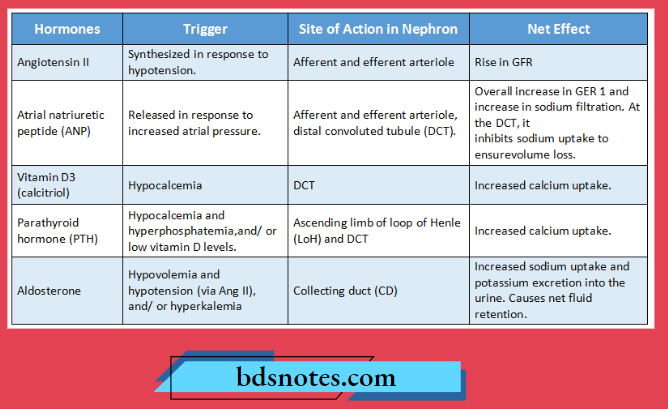
Question 3. Give the volume of urine excreted per day. Mention the three mechanisms Involved in urine formation.
Answer:
Daily urinary output:
- Normally about 11.5 litres of urine is formed per day.
Mechanism of urine formation:
It includes three processes:
- Glomerular filtration
- Tubular reabsorption
- Tubular secretion
Question 4. Role of renin in regulation of blood pressure.
Answer:

Leave a Reply