Rickets
Write a short note on rickets.
Or
Write briefly on rickets.
Answer:
Rickets refers to the disorder that occurs due to a deficiency of vitamin D.
- Primary defects in rickets are interference with the mineralization of bone and deranged endochondral and intramembranous bone growth.
- It develops in an area where sunlight is deficient.
- It also results from inadequate extracellular levels of calcium and inorganic phosphate, a mineral necessary for new bone to calcify. Osteoid builds in excessive amounts because it fails to mineralize properly.
Rickets
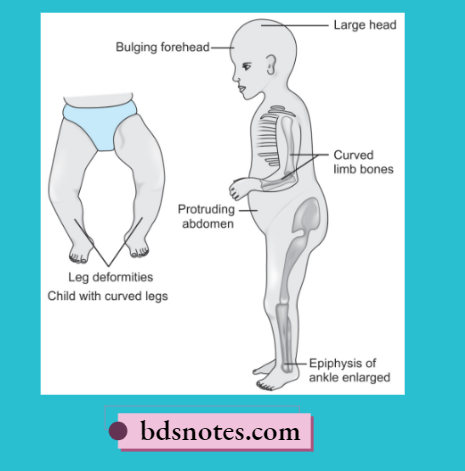
Rickets Clinical Features
- It occurs in infants and children.
- Wrist and ankles are typically swollen. The changes in bone are found in the epiphyseal plates, metaphysis, and the shaft.
- Craniotabes, i.e. localized areas of thinning are present in the skull, when a finger pressure is applied it can produce indentation.
- The patient has a short stature and deformed extremities. Children with rickets show bowing of legs.
- Harrison’s sulcus is present, i.e. indentation of lower ribs at the site of attachment of the diaphragm.
- The rachitic rosary is the deformity of the chest due to cartilaginous overgrowth at the costochondral junction.
- Pigeon chest deformity is the anterior protrusion of the sternum due to the action of respiratory muscles.
- Frontal bossing is present.
- Knock knees are present due to enlarged ends of the femur, tibia, and fibula.
- Lumbar lordosis—the pelvis may be deformed. When an ambulatory child develops rickets, deformities are likely to affect the spine, pelvis, and long bones causing ’lumbar lordosis’.
Rickets in children
Rickets Histopathology
- In long tubular bones
- The proliferation of cartilage cells at epiphysis is followed by inadequate provisional mineralization.
- Overgrowth of epiphyseal cartilage is present with deposition of the osteoid matrix in inadequately mineralized cartilage resulting in enlarged and expanded costochondral junction.
- Irregular overgrowth of small blood vessels in disorganized and weak bones.
- In flat bones
- Mesenchymal cells differentiate in osteoblasts with the laying down of osteoid matrix which fails to get mineralized resulting in weak and soft flat bones.
Rickets treatment and prevention
Rickets Biochemical Changes
- The lower level of active metabolites of vitamin D.
- Plasma calcium levels are slightly low or normal.
- Plasma phosphate levels are lowered.
- Plasma alkaline phosphatase is raised.
Leave a Reply